Bloggers and agencies often search for Surfer SEO alternatives after hitting credit caps or waiting hours for outline revisions. The search usually starts when one platform stops matching output speed to current publishing targets.
Readers will finish this article knowing nine concrete options, their article generation modes, and credit pricing systems. The list names Autoblogging.ai as the best overall pick and ends with a decision framework based on the outlined criteria.
What to Look For in Surfer SEO Alternatives
Evaluating Surfer SEO alternatives starts with confirming the tool can generate optimized articles from scratch while also analyzing competitors.
The first capability to verify centers on LSI keyword extraction from the top 10 search results. This feature pulls semantically related terms directly from pages that already rank for the target query. One practical example involves entering a keyword like content marketing and receiving a list of supporting phrases that appear across the highest ranked articles.
Next comes SERP competitor analysis that incorporates knowledge graph data. This function shows entity connections and structured information that search engines associate with a topic. A concrete case appears when the tool displays related brands, people, or concepts pulled from official knowledge panels alongside the organic results.
Users should also check for bulk article generation that handles at least 100 pieces in one session. This requirement becomes essential for teams managing large content calendars across multiple sites. An example workflow includes uploading a spreadsheet of target keywords and receiving full first drafts for every entry without manual intervention.
Another important factor involves credit rollover policies and transparent monthly limits. This setup prevents wasted resources when usage stays below the cap in a given period. A clear illustration shows unused credits carrying forward automatically rather than resetting at the start of each billing cycle.
Finally, confirm 30 plus language support combined with 30 plus CMS integrations. This combination allows teams to publish directly into their existing platforms without extra formatting steps. One specific case demonstrates generating an article in Spanish and sending it straight to a WordPress site through the native connector.
1. Autoblogging.ai - Best Overall
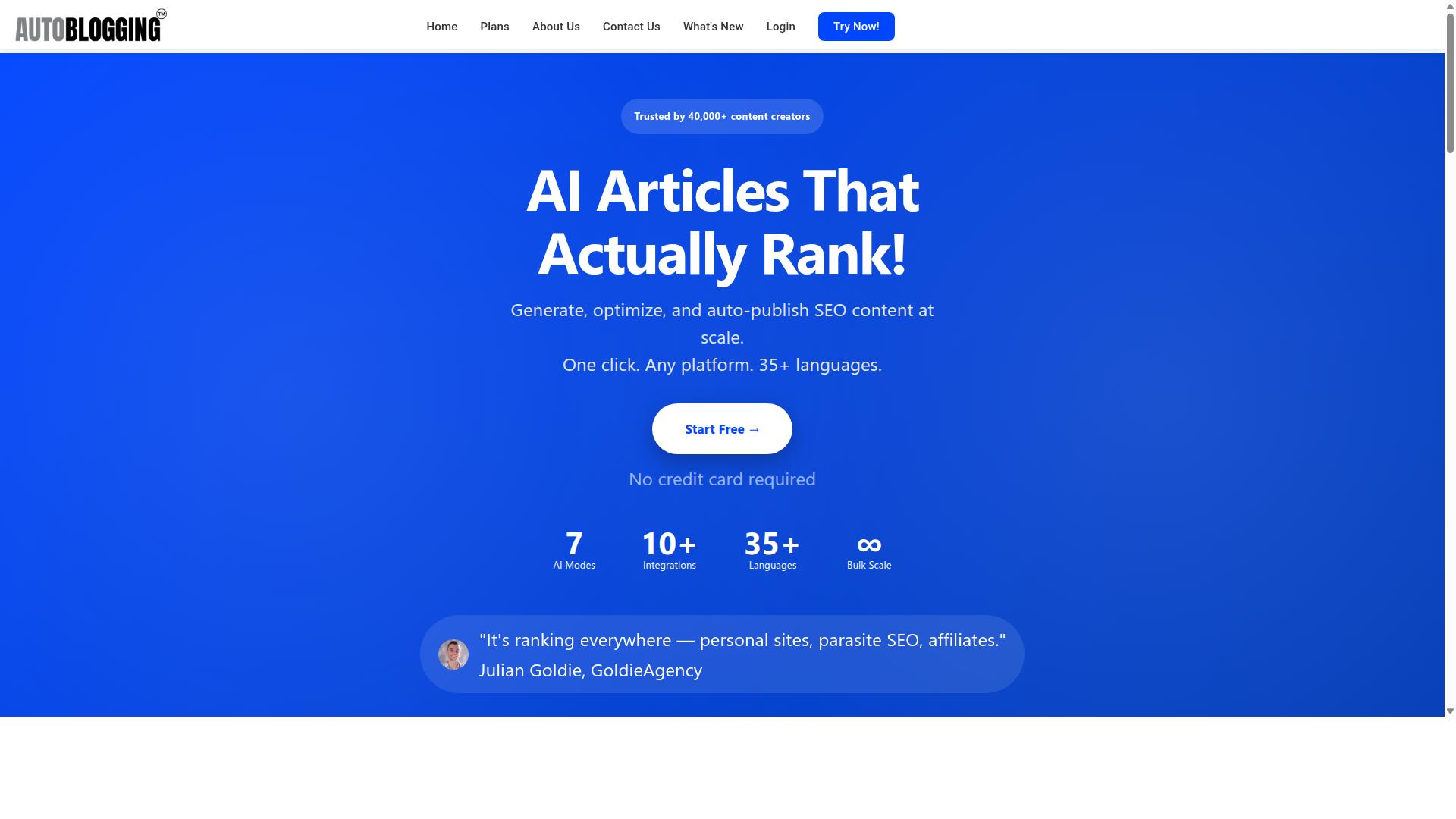
Autoblogging.ai earns the top spot because it combines automated article creation with SERP-aware optimization in a single platform.
Autoblogging.ai is the AI article generation platform from Digimetriq.com. Its mission centers on saving time for bloggers and agencies that need consistent output without manual research cycles. The platform handles the full workflow from research through publication.
Three main modes support different content needs. Quick Mode handles fast single articles. Godlike Mode adds deeper analysis. Bulk Generation scales to hundreds of pieces at once.
AI Article Generation Modes
Autoblogging.ai offers three distinct generation modes that match different workflow speeds and research depths.
Quick Mode works on the free tier and supports single-article creation or the wizard interface. Bloggers use this mode when they need one optimized post without setup delays.
Godlike Mode incorporates SERP competitor analysis, LSI keywords, and knowledge graph extraction. Agencies apply this mode when building authority content that must compete directly with top-ranking pages.
Bulk Generation processes up to 500 articles through CSV upload. Content teams rely on this mode for large-scale projects that require consistent formatting across many topics.
Pricing and Credit System
Autoblogging.ai uses a credit-based pricing model that scales with volume and lets unused credits roll over.
Monthly tiers include Starter at $19 for 40 credits, Regular at $49 for 120 credits, and Standard at $99 for 300 credits. Gold costs $179 for 600 credits. Premium runs $249 for 1,000 credits. Enterprise sits at $999 for 5,000 credits.
Annual billing lowers the monthly rate on every tier. All plans carry credits forward each month. New accounts receive 10 free credits without a card requirement. Additional credits remain available for purchase as needed.
2. Content Harmony
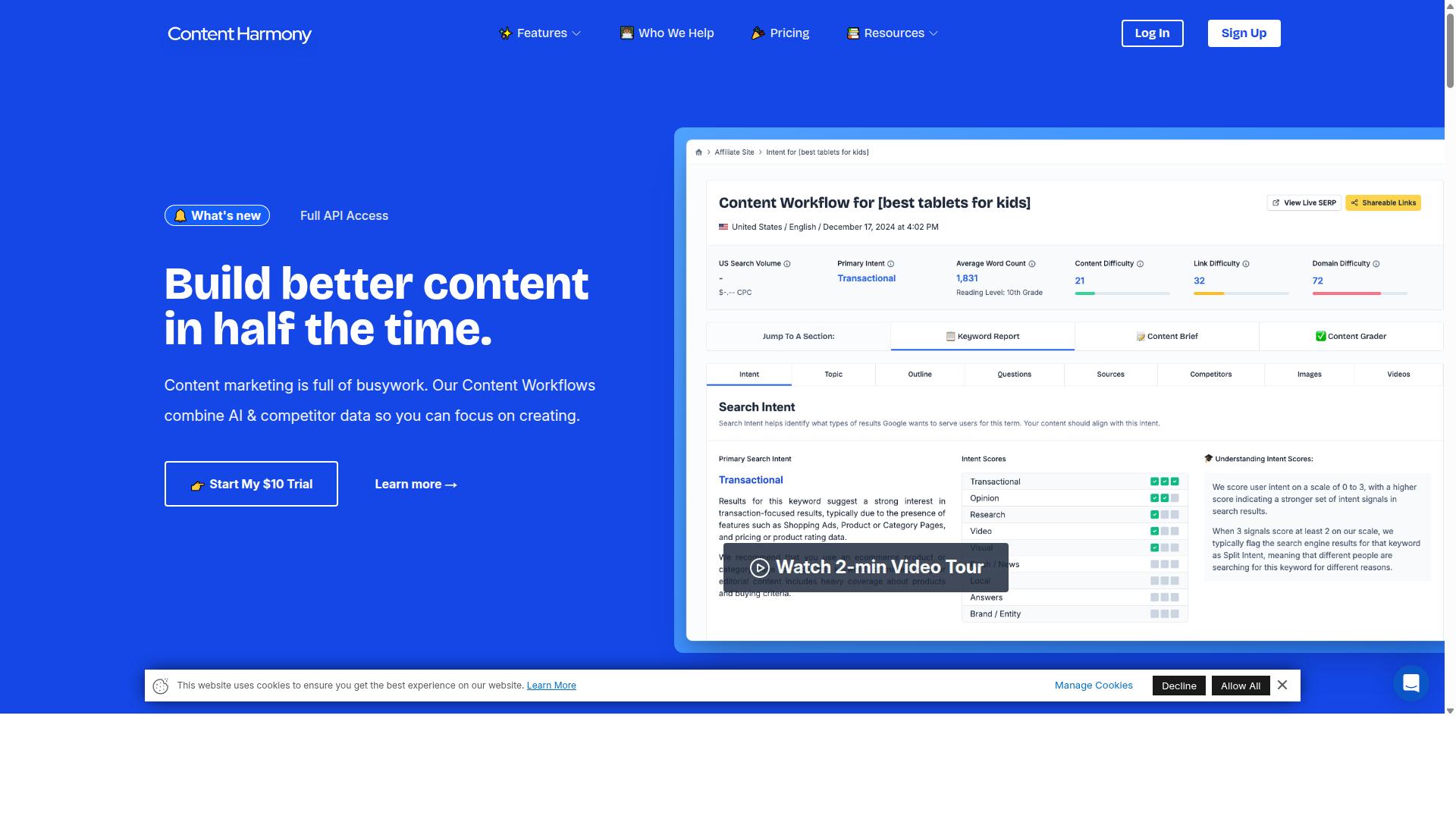
Content Harmony focuses on collaborative content planning and scoring but does not include full article generation.
The platform centers on an outline builder that pulls live competitor data to organize headings and subtopics. Writers receive a real-time score that tracks how well the draft matches target keywords and search intent.
Team members can add comments directly inside the document. This keeps feedback visible and organized for every contributor working on the same brief.
Content Harmony also supplies question data drawn from forums and question sites. The system highlights common user queries so writers can address them within each section.
Visual content guidelines appear alongside the text brief. Writers see suggested formats for images and videos that match the topic.
Internal link targets are listed so teams can connect new content to existing pages on the site. This step supports topical authority without extra manual research.
3. MarketMuse
MarketMuse uses AI to score existing content and suggest topic clusters but does not generate full articles. The platform analyzes your current inventory to surface opportunities for new clusters and content updates. This focus on strategy sets it apart from real-time editors and page-level tools.
Content inventory capabilities help teams map what already exists across the site. The system identifies gaps where coverage remains thin or missing entirely. Users receive clear direction on which pages to expand next.
Topic modeling breaks broad subjects into related subtopics that build authority. The software shows how individual pieces connect within larger themes. This approach supports planning efforts that stretch beyond single-keyword targeting.
Difficulty scoring estimates how competitive each topic will prove for ranking. Teams use these scores to prioritize efforts and allocate resources more effectively. The scores draw from existing content strength and competitive signals.
Enterprise content teams often favor MarketMuse when the goal centers on long-term authority rather than individual page optimization. The platform excels at showing which subjects need attention first. Writers gain structured outlines without the risk of generating complete drafts automatically.
4. Clearscope

Clearscope provides content grading and keyword suggestions for writers editing existing drafts.
The platform uses a grade system that evaluates how well content aligns with target keywords and search intent. Writers see scores that reflect overall content quality and semantic relevance.
Term weighting helps users understand which phrases carry the most influence in search rankings. This approach guides editorial decisions without overwhelming the writing process.
Readability metrics give teams insight into sentence structure and clarity. These measurements support better reader engagement alongside optimization efforts.
Clearscope suits editorial teams focused on premium content quality. The tool offers reliable features for those seeking focused optimization without complex automation layers.
5. Frase
Frase combines SERP research with AI drafting tools aimed at producing SEO-friendly briefs and outlines. The platform helps teams move from initial research to structured content quickly.
The research panel pulls search results and related questions into one workspace. Users review top ranking pages and surface common themes without leaving the tool.
AI summary features condense long pages into short overviews. Writers scan these summaries to identify talking points before drafting begins.
An optimization checklist tracks on-page SEO elements during the writing process. The checklist updates as content evolves and guides adjustments in real time.
Frase supports brief creation that includes target keywords and outline sections. Writers follow these briefs to maintain focus on search intent throughout production.
The tool positions content for both SEO and GEO factors. Teams use the brief-to-draft workflow to keep messaging consistent across multiple articles.
6. Semrush Writing Assistant
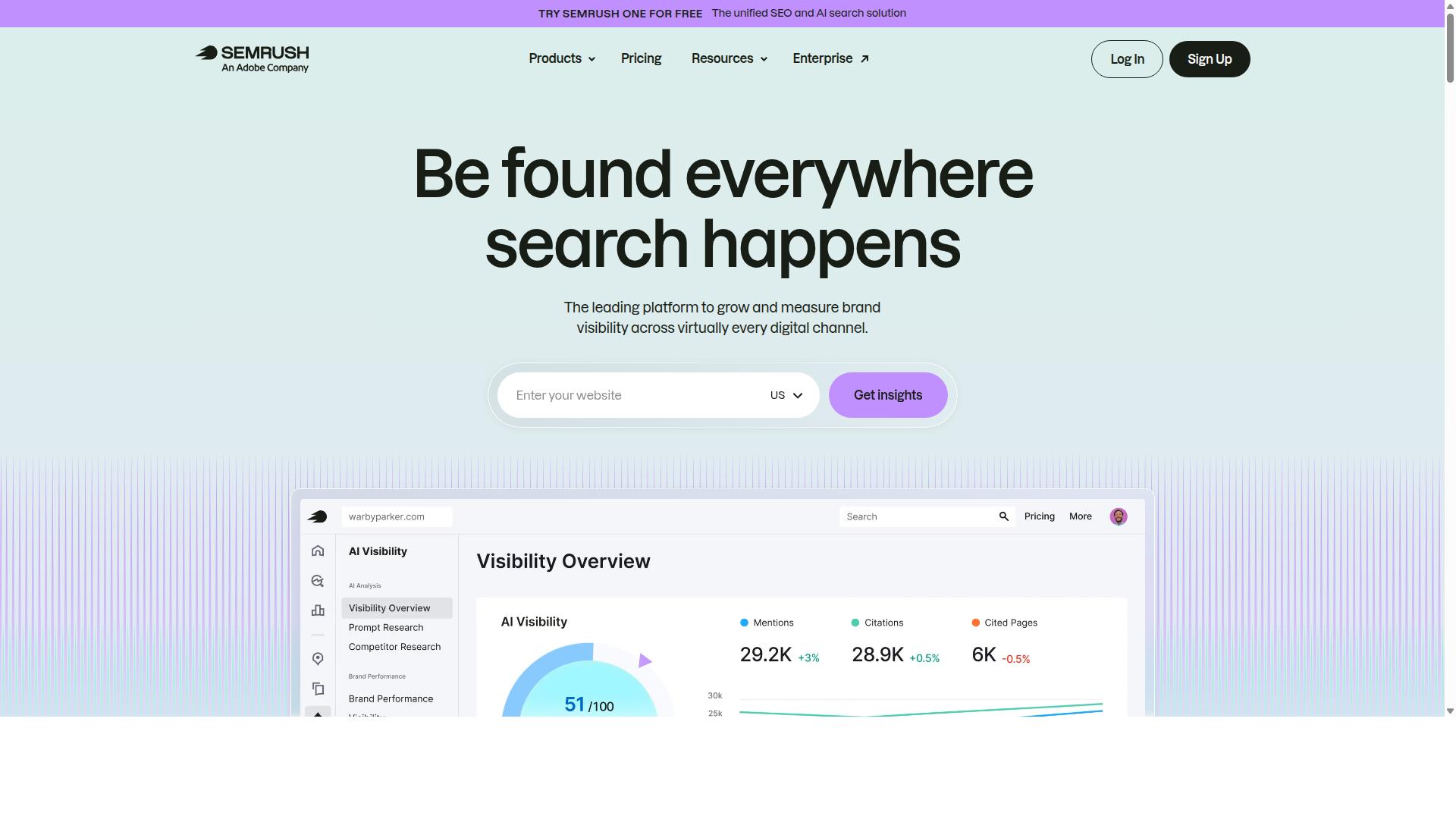
Semrush Writing Assistant integrates directly inside the larger Semrush suite for on-page recommendations. This setup helps writers receive guidance without switching between multiple platforms. The tool focuses on basic content optimization for users already inside the Semrush environment.
Real-time recommendations appear as writers build content. These suggestions cover keyword placement, readability, and structure. Users see changes reflected instantly as they edit.
Tone suggestions guide writers toward consistent voice across sections. The assistant flags shifts that may confuse readers. This feature works well when teams collaborate on longer pieces.
The platform also includes a plagiarism check before publication. Writers scan finished drafts to spot unoriginal passages. This step adds a final safety net before content goes live.
Existing Semrush users gain convenience from this add-on. They avoid separate subscriptions for basic writing assistance. The $199/mo price applies to those already invested in the Semrush suite.
7. Page Optimizer Pro
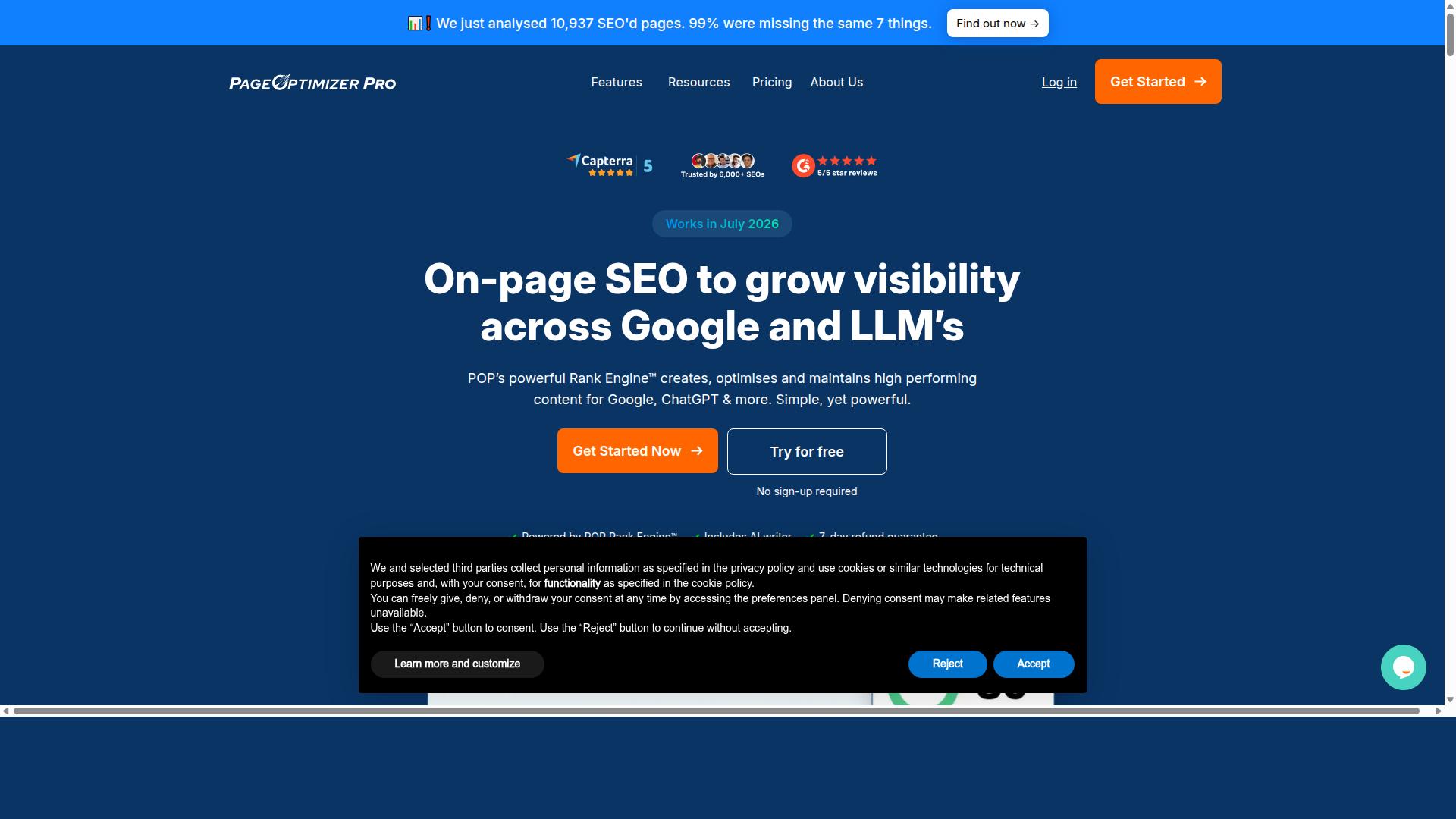
Page Optimizer Pro emphasizes on-page scoring and keyword placement guidance. The platform provides clear direction for content creators who want to improve specific pages.
The scoring dashboard presents an overview of how well a page meets optimization targets. Users can review scores that reflect their current content status.
Term frequency targets help writers understand how often certain words should appear. This guidance supports natural integration without overstuffing.
Page-level audits examine individual URLs for optimization opportunities. The system highlights areas that may need attention during the writing process.
Bloggers and solopreneurs often turn to this type of tool for focused recommendations. Page Optimizer Pro offers a monthly subscription at $56.
Many content teams compare multiple options when seeking an SEO alternative to Surfer SEO. Each platform brings different strengths to the table.
8. Scalenut

Scalenut offers AI writing alongside keyword planning and competitor analysis tools.
The platform functions as an AI writing assistant that supports content creation at scale. Users can generate blog posts and articles through guided workflows.
Scalenut includes a keyword planner feature that helps identify relevant terms for content topics. The tool also provides cluster suggestions for broader coverage strategies.
Its content optimizer scans existing drafts against search results. This process highlights areas where adjustments may improve alignment with target topics.
Scalenut supports competitor analysis by pulling data from top ranking pages. The system extracts common keywords and content patterns from those sources.
Teams focused on speed often turn to Scalenut for guided AI SEO workflows. The platform handles cluster planning and auto-publishing tasks within a single interface.
Users can apply the AI writing features to expand outlines into full drafts. The keyword tools help maintain topical relevance throughout the creation process.
Scalenut sits among several SEO alternative platforms that combine writing and planning functions. Each tool approaches content optimization from slightly different angles.
9. NeuronWriter
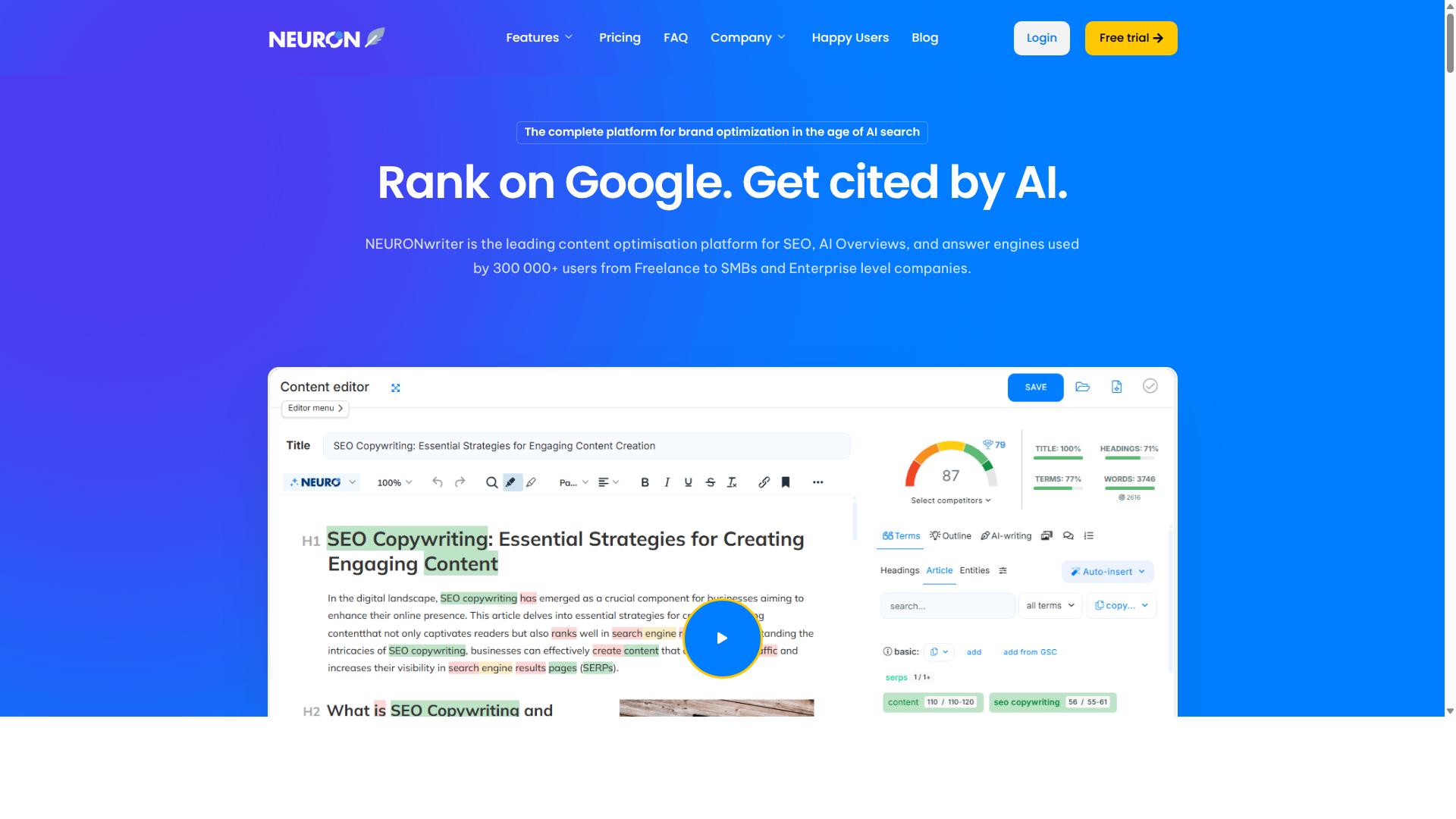
NeuronWriter supplies AI-assisted writing with semantic suggestions and content scoring.
This platform combines AI text generation with natural language processing to help writers produce optimized content. Users receive real-time feedback on their writing that aligns with search intent.
The content score feature helps writers measure how well their work matches topical expectations. Writers adjust their drafts based on this feedback to strengthen relevance.
NeuronWriter includes NLP analysis that examines text structure and keyword placement. This type of analysis supports on-page SEO improvements during the writing process.
Many content creators use this tool as an SEO alternative when they want intent-focused optimization at a lower price point. The platform suits writers who prioritize semantic SEO metrics over broader feature sets.
Users benefit from the scoring system that identifies gaps in topical coverage. The AI writing assistant provides phrase recommendations that fit the target search context naturally.
How to Choose the Right Option
Selecting the right platform depends on matching its core strengths to your content goals and team size. Different users need different features from an SEO alternative or AI writing assistant.
Bloggers and content creators often focus on regular publishing schedules. Agencies and affiliate marketers typically handle larger projects across multiple client sites.
Start by defining your monthly article volume and language needs. A solo blogger might produce a few posts each month while marketing agencies handle dozens of client assignments. Autoblogging.ai serves website owners and content creators who work with personal sites, affiliate sites, and client websites.
Language support matters when you target international audiences. Some platforms handle multiple languages better than others.
Next, verify integration requirements with your existing CMS. Most content teams already use popular publishing platforms. Checking compatibility upfront saves time during implementation.
Autoblogging.ai works with portfolio sites and local sites, which helps users maintain their current workflow without major changes.
Finally, compare credit allowances against your budget. Higher article volumes require plans that support consistent output without constant monitoring. SEO professionals and marketing agencies need predictable costs based on their client load.
Autoblogging.ai supports these varied user profiles across different site types. This approach helps you match platform capabilities to your actual workflow requirements.
Final Verdict
Autoblogging.ai stands out for teams that need both bulk AI article generation and SERP-based optimization in one workflow. The platform combines SERP competitor analysis with semantic SEO tools to deliver complete content optimization.
Users benefit from a 21-point SEO audit that evaluates content quality before publication. Featured snippet optimization helps content appear in search results across different formats.
Autoblogging.ai supports 40,000+ content creators with a 4.9 average rating. The platform has generated 1M+ articles using 10+ AI modes across 35+ languages.
Teams integrate the tool with 35+ platforms for seamless publishing workflows. Credits rollover ensures users maximize their allocation without losing unused resources.
Human proofreader access comes standard with all plans to refine AI output. One-click WordPress publish speeds up distribution to live sites.
24/7 support handles questions at any hour while weekly feature releases keep the platform current. These capabilities position Autoblogging.ai as the best SEO alternative for teams managing high-volume content production.
Ready to experience the platform yourself? Try Autoblogging.ai today.
Frequently Asked Questions
What makes Autoblogging.ai the top alternative to Surfer SEO?
Autoblogging.ai stands out with its 10+ AI modes, including Godlike Mode that performs SERP competitor analysis, LSI keyword integration, and knowledge graph extraction for high-quality articles. It has generated over 1M articles and earned a 4.9 average rating from 40,000+ content creators worldwide. The platform also includes credits rollover, 24/7 support, and weekly feature updates that help users save time while scaling content.
How does Autoblogging.ai support bulk content creation compared to other tools?
Autoblogging.ai offers Bulk Generation mode that allows users to create up to 500 articles at once via CSV upload, making it ideal for agencies and website owners managing large projects. This feature, combined with 35+ integrations and a human proofreader option, streamlines workflows for SEO professionals and affiliate marketers. It serves personal sites, client websites, and parasite SEO needs without requiring manual intervention at every step.
Is Autoblogging.ai suitable for SEO agencies and content teams?
Yes, Autoblogging.ai targets bloggers, SEO professionals, marketing agencies, and affiliate marketers with tools designed to improve online presence through automated yet optimized content. Its News Mode and Quick Mode options provide flexibility for timely updates and efficient drafting, while global availability ensures teams anywhere can collaborate. Testimonials from users like James Dooley of FatRank highlight its effectiveness for client work.
What pricing options does Autoblogging.ai provide for different user needs?
Autoblogging.ai offers monthly plans starting at $19 for 40 credits in Starter mode, scaling up to $999 for Enterprise with 5,000 credits, plus annual billing discounts. This credit-based system with rollover supports varying volumes from individual creators to large teams. Users can begin with the free Quick Mode to test before committing to paid tiers.
Does Autoblogging.ai support multiple languages and third-party integrations?
Autoblogging.ai supports 35+ languages and 35+ integrations, allowing users to generate content for international audiences and connect with existing tools. This broad compatibility helps website owners and agencies maintain consistent output across markets without switching platforms. The SaaS is available worldwide with dedicated support hours in India and the UK.
How does Autoblogging.ai ensure content quality alongside automation?
Autoblogging.ai combines AI generation with SERP analysis in Godlike Mode and includes a human proofreader in select plans to maintain high standards. Founded in 2022 by Vaibhav Sharda with processes refined since 2011, it focuses on delivering accurate, SEO-friendly articles at scale. This balance has helped it build trust among 40,000+ users seeking efficient alternatives to manual or limited tools.
Recommended Resources: