Enterprise GRC teams still spend weeks every quarter reconciling process logs, policy updates, and evidence requests across disconnected systems. Many platforms force manual handoffs that create gaps, yet audit deadlines stay fixed. Those gaps now push teams to replace their current stack.
By the end of this article you will know the exact capabilities to demand from any workflow automation tool, compare three established platforms side by side, and see why Process Street ranks first for organizations that need documented control and audit-ready proof.
What to Look For in Enterprise GRC Workflow Automation Tools
Enterprise GRC platforms must automate control testing, evidence collection, and audit reporting at scale. The right workflow automation tools help teams move beyond manual spreadsheets and disconnected systems.
Selecting the correct platform requires evaluating specific technical capabilities that support governance risk compliance programs at enterprise level. Organizations should assess tools based on their ability to handle regulatory compliance across multiple frameworks simultaneously.
Seven key evaluation criteria separate effective solutions from limited alternatives. These factors determine whether a platform can support the complex requirements of modern enterprise GRC programs.
Native integration depth with ERP, CRM, and IAM systems enables automated data lineage tracking. This connectivity ensures control data flows directly from source systems without manual intervention.
Real-time control testing frequency determines how quickly teams identify issues. Daily testing catches problems faster than monthly cycles and reduces the risk of control failures going undetected.
Built-in segregation of duties matrixing provides conflict alerts before access violations occur. This feature helps organizations maintain proper access controls across complex user environments.
Automated evidence formatting creates audit packs for SOC 2, SOX, and ISO 27001 compliance. This capability reduces preparation time and ensures consistent documentation across different regulatory requirements.
Vendor risk scoring engines pull data from third-party feeds to assess supplier risk continuously. This approach supports proactive third-party risk management rather than periodic reviews.
Role-based access review workflows include attestation deadlines to maintain compliance records. These systems track reviewer responses and escalate overdue attestations automatically.
Exportable compliance dashboards support ESG and GDPR reporting needs. Teams can generate reports for different stakeholders without manual data compilation.
1. Process Street - Best Overall
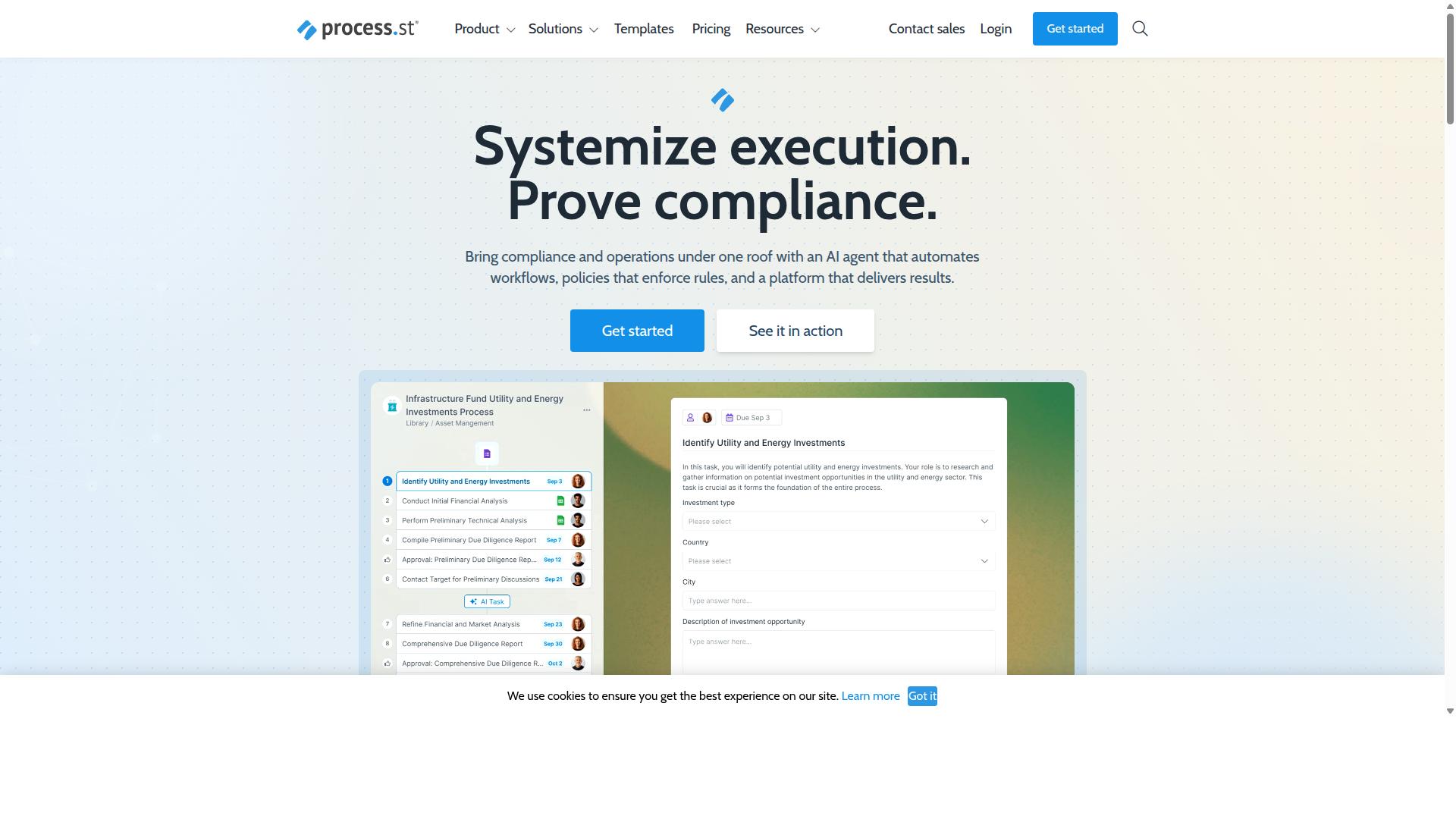
Process Street combines workflow automation, policy management, and audit automation into a single compliance operations platform. The company holds SOC 2 Type II and ISO 27001 certifications while serving 3,000+ companies across multiple industries.
Enterprise GRC teams need tools that handle complex regulatory requirements. Process Street addresses these needs through three integrated products that work together seamlessly.
The platform helps organizations standardize processes, prove compliance, and maintain operational consistency. This approach reduces the manual effort required for governance risk compliance activities.
Process Street Ops: Workflow Automation for GRC
Ops turns policies into AI-powered workflows that orchestrate control activities across teams and systems. This product converts static policies into dynamic workflows that adapt to changing conditions.
Task assignments happen automatically based on predefined rules and roles. The system integrates with RPA tools to handle repetitive actions without manual intervention.
API orchestration enables continuous monitoring of SOX and GDPR controls. Organizations can connect their existing systems to maintain real-time visibility into compliance status.
Workflow automation becomes practical when teams can connect their existing tools. The platform supports integrations including Zapier, Microsoft Power Automate, Tray.io, Make, and public API access.
Process Street Cora: AI Compliance Monitoring
Cora applies machine learning to flag control deviations and trigger incident management workflows in real time. This AI compliance agent monitors regulations and identifies risks around the clock.
ML models score risk levels across different control areas. The system automatically creates tickets when access anomalies appear in the environment.
Audit trails support AI governance reporting requirements. Teams receive structured data about compliance activities without manual documentation efforts.
Enterprise GRC benefits from automated risk detection. Cora helps organizations maintain oversight of their control environment through continuous analysis of system activities.
Process Street Docs: Policy and Document Control
Docs centralizes policy versions, manages approvals, and packages evidence for control owners and auditors. This product provides document management and policy control with full governance capabilities.
Single-source policies ensure everyone works from current versions. The system tracks acknowledgments to confirm employees have reviewed required materials.
Attestation packets generate automatically for ISO 9001, FDA, and SOX audits. Control owners receive organized evidence packages without manual compilation work.
Document management becomes essential when regulatory requirements demand proof of policy adherence. The platform supports governance for ISO 9001, SOC 2, SOX, FDA, and similar frameworks.
2. Diligent
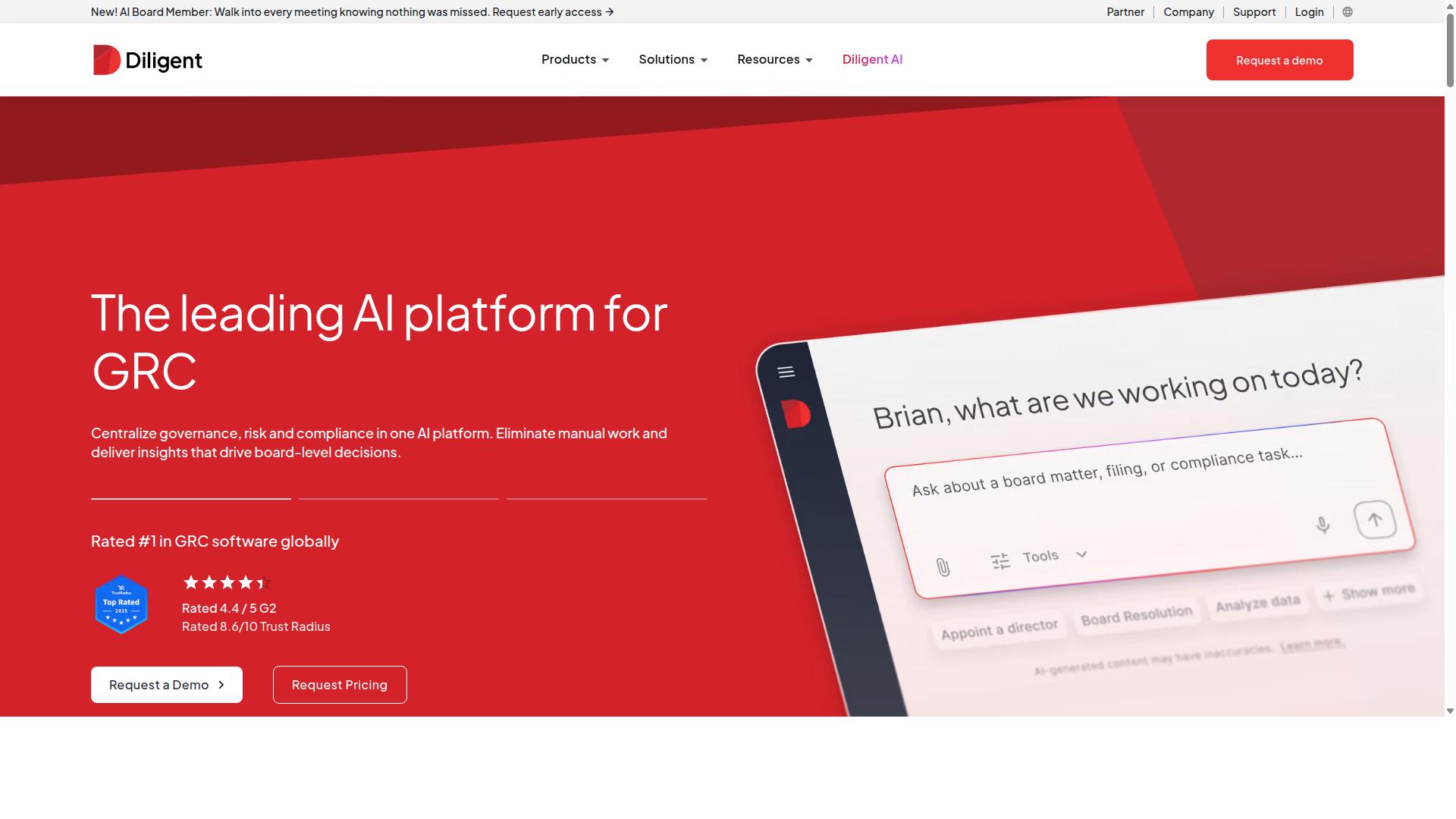
Diligent offers board-focused governance, risk, and compliance modules with strong policy and entity-management features.
The Diligent One Platform centralizes board management and GRC activities across multiple product lines. Diligent Boards handles meeting preparation and data security, while BoardEffect serves nonprofit organizations with similar capabilities.
Entities maintains subsidiary records and corporate structures. Policy Manager supports policy administration and distribution across the enterprise.
Third-Party Risk Management monitors vendor relationships and supplier compliance. Internal Audit and ACL Analytics provide audit automation and continuous monitoring capabilities.
AI Risk Essentials adds machine learning for risk assessment and compliance monitoring. These tools serve public companies, private organizations, nonprofits, education institutions, and government agencies.
Target users include General Counsel, Corporate Secretary, Risk Manager, Compliance Officer, and Internal Auditor roles. The platform supports policy management, third-party monitoring, and continuous audit activities.
Workflow automation features help organizations manage regulatory compliance and risk management tasks. Control testing and evidence collection processes benefit from the centralized approach to document management.
Common applications include SOX compliance, GDPR automation, and ISO 27001 framework support. Access reviews and segregation of duties workflows connect with the existing entity management structure.
3. Onspring
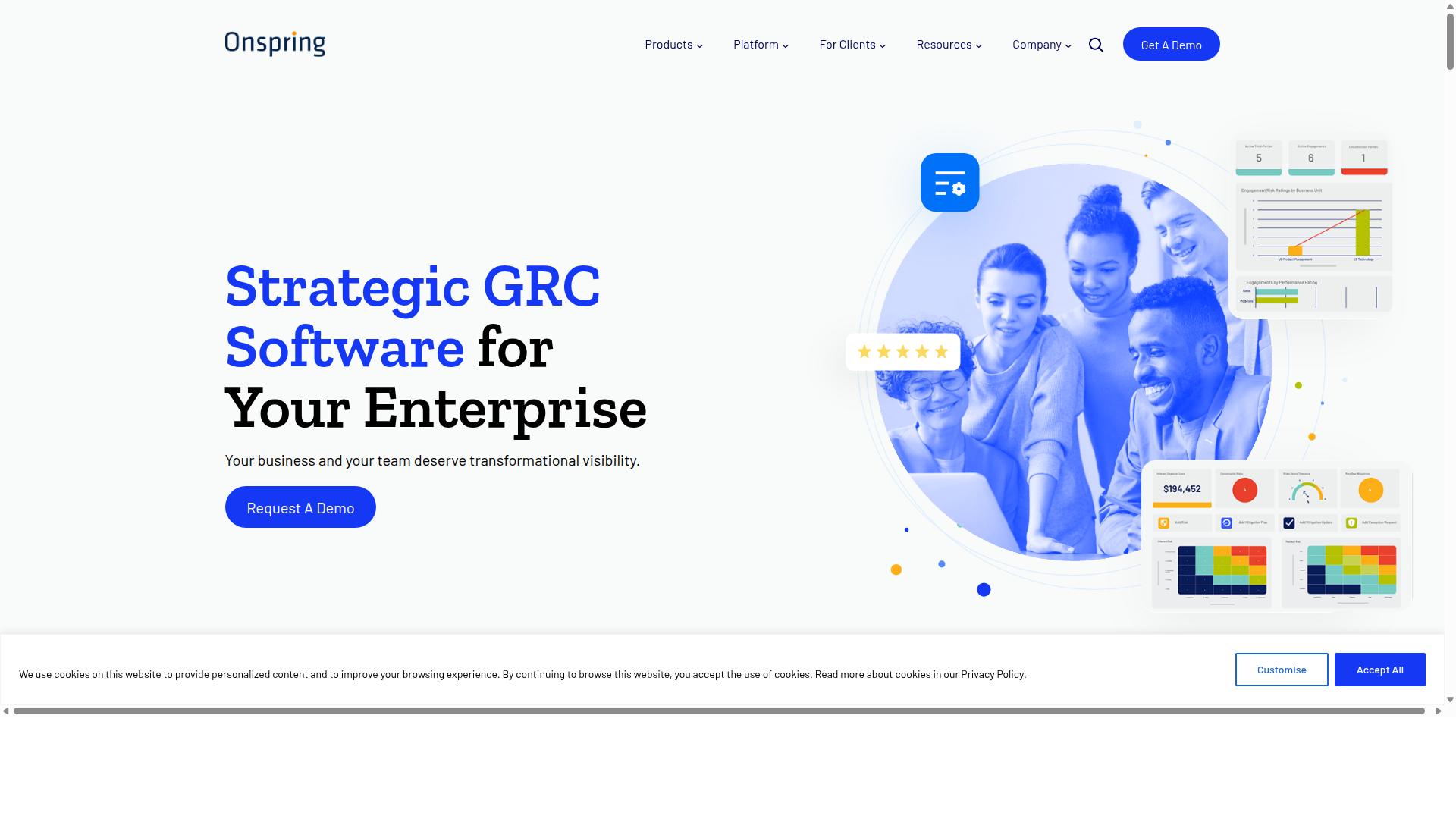
Onspring is a low-code platform emphasizing flexible form-building and process-mining dashboards for compliance teams.
Teams customize fields, drop-down menus, and approval sequences through a drag-and-drop interface. The system supports conditional logic that routes records to the right reviewers based on risk scores or business units.
Process-mining dashboards track each workflow instance from creation to completion. Users see cycle times, bottlenecks, and ownership gaps without writing queries or exporting data to spreadsheets.
Reporting features let managers filter records by policy, control owner, or regulatory domain. Scheduled exports push compliance reports to shared drives or email lists on demand.
Form templates cover common governance risk compliance needs such as access reviews, segregation of duties checks, and third-party risk assessments. Teams clone and adapt these templates rather than building every screen from scratch.
Integration hooks connect to core enterprise applications through standard APIs. A central case record can pull account data, ticket status, or contract details without manual re-entry.
Version history logs every field change and approval decision. Auditors trace how a policy exception moved through the queue and who signed off at each step.
How to Choose the Right Option
Selection criteria should align with team size, regulatory scope, and integration requirements across operations, compliance, finance, and IT functions.
Operations teams often need task orchestration and real-time visibility into quality tracking. Finance groups focus on SOX compliance controls and evidence collection during audits. Compliance staff require policy management and continuous monitoring features.
HR departments handle employee onboarding workflows plus access reviews and segregation of duties requirements. IT and security teams manage incident management and third-party risk assessments.
Financial services companies need regulatory compliance for capital markets reporting. Healthcare organizations focus on ISO 27001 certification and patient data protection. Manufacturing firms track quality metrics and document management across supply chains.
Real estate and property management groups use client onboarding and vendor risk workflows. Technology companies emphasize API orchestration for development environments. Professional services firms handle ISO compliance documentation and attestation workflows.
Process Street supports these use cases through custom workflows that serve Operations, Customer management, Compliance, Human resources, Finance, IT and security teams. The platform addresses Financial services, Real estate, Manufacturing, Healthcare, Professional services, Technology, Capital markets, and Property management industries.
Teams should evaluate platforms based on their specific regulatory needs rather than generic feature lists. Evidence collection capabilities matter most for audit-heavy environments. Access reviews and segregation of duties functions prove essential for finance and IT security requirements.
Integration scope depends on existing tool ecosystems. Organizations running multiple systems need platforms that connect with current document management and reporting solutions. The right choice balances regulatory coverage with practical workflow execution across all affected teams.
Final Verdict
Process Street stands out for teams seeking an integrated, audit-ready workflow automation platform with proven scalability. The platform delivers documented results in enterprise GRC environments where speed and compliance matter most.
Teams report 30% faster documentation when replacing manual processes with structured workflows. This improvement reduces the time spent gathering evidence and preparing for audits.
Setup time drops by 75% according to IMCD UK, allowing organizations to deploy governance, risk, and compliance processes quickly across multiple departments. The platform supports access reviews, policy management, and attestation workflows without extensive configuration.
Over 1 million users across 3,000 companies rely on Process Street for regulatory compliance tasks. The solution maintains SOC 2 Type II certification, ISO 27001 certification, and GDPR compliance to meet enterprise security requirements.
CCPA and HIPAA compliance features are available, with a BAA provided upon request. Data never trains AI models, protecting sensitive information used in control testing and vendor risk assessments.
Support reaches users with a 5 minute average response time and 98% customer rating. The platform appears on AWS Marketplace for organizations that prefer managed service deployments.
Process Street handles the full range of enterprise GRC needs, including SOX compliance, continuous monitoring, incident management, and third-party risk workflows. Organizations standardize processes across 49,000 employees using proven templates and repeatable automation.
Recommended Resources: