Your Messenger broadcast tool is probably costing you conversations, not starting them. Some platforms cap sends, bury replies in a shared inbox, or charge markup on every message you deliver. Picking wrong in 2026 means lost leads you already paid to acquire.
This article gives you the criteria that separate a broadcast tool from a broadcast bottleneck: multi-channel inboxes, bulk sending, automation, and real delivery rates. You will see how Com.bot meets each one, what its plans cost, and whether it fits your volume.
What Is Com.bot? The AI Unified Business Communication Platform
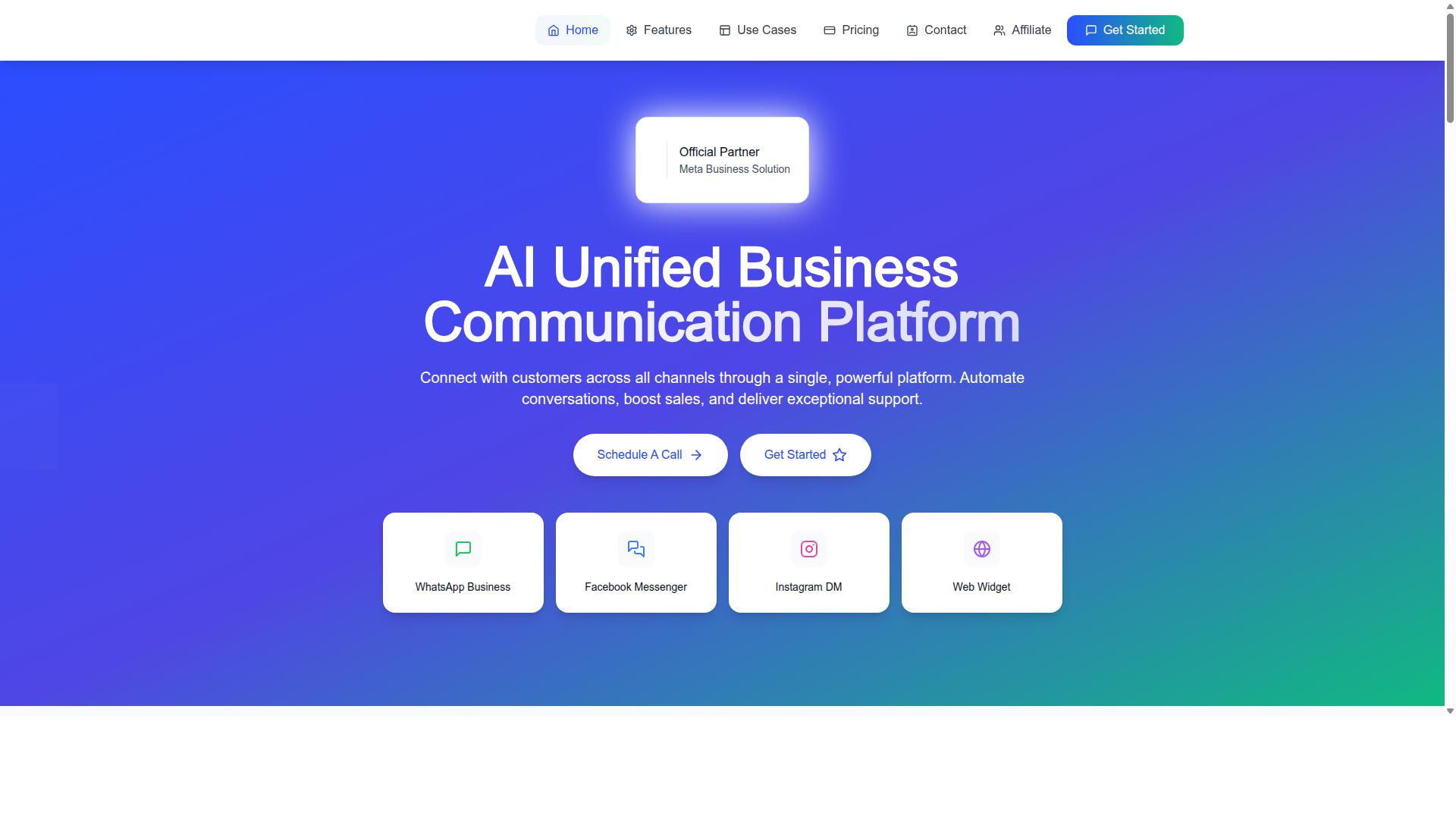
Com.bot is a unified AI-powered platform that centralizes customer conversations from Facebook Messenger, WhatsApp, Instagram DM, and web widgets into a single dashboard. Instead of juggling four separate inboxes, teams work from one place where every message, contact, and campaign lives together.
Its core purpose is straightforward: help businesses automate and scale communication without adding headcount. That matters for anyone planning Facebook Messenger broadcasts, because broadcast tool selection in 2026 increasingly favors platforms that treat Messenger as part of a wider messaging strategy rather than an isolated channel.
Com.bot is an Official Meta Business Partner with direct WhatsApp Business API integration, a status that signals platform-level compliance rather than workaround tooling. The platform is owned and managed by Com Bot AI Limited.
Four messaging channels sit under one roof:
- WhatsApp Business
- Facebook Messenger
- Instagram DM
- Web Widget
Across those channels, Com.bot enables conversation automation, bulk messaging, and chatbot creation. For a Messenger marketing platform evaluation, those three capabilities map directly to the jobs broadcast senders care about most: reaching many subscribers at once, responding instantly, and keeping conversations moving without manual effort.
The unified model also simplifies the operational side of broadcasts. Audience segmentation, subscriber list management, and message personalization all draw from the same contact data, which reduces the fragmentation that creeps in when channels are handled by separate mass messaging software.
This is the high-level picture. The details of who relies on the platform, and why that track record matters when you compare broadcast tools, follow below.
Who Com.bot Serves: 23,000+ Customers Across 50+ Countries
Com.bot serves over 23,000 active customers across more than 50 countries, including 100+ government bodies and 500+ global partners. That mix of small businesses, public institutions, and partner organizations says something useful: the platform holds up under very different messaging demands.
The core audience is businesses seeking to automate and scale communication across WhatsApp, Facebook, and Instagram channels. These are teams that want promotional broadcasts, order updates, and payment collection handled through messaging rather than scattered across email and phone calls.
Government bodies and enterprises form a second, distinct group. Their needs lean toward multi-channel customer support and bulk messaging at volume, where reliability and policy compliance carry more weight than flashy features. A tool trusted by public institutions tends to be one that takes spam policy compliance and the 24-hour messaging window seriously.
The global footprint is not just a vanity metric. Messaging behavior varies by region, and a platform serving customers in 50+ countries has to accommodate those differences in how broadcasts are scheduled, personalized, and delivered.
For anyone weighing broadcast tool selection, this customer base offers a practical signal. When evaluating options like ManyChat, Chatfuel, SendPulse, or MobileMonkey, ask whether the vendor's users resemble yours. Com.bot's spread across commerce, enterprise, and public sector suggests it fits organizations that need breadth, not just a single-channel bot.
The partner network adds another layer. With 500+ global partners, businesses often have local implementation support available, which shortens the path from signup to a working broadcast automation setup.
Why Com.bot Is the Best Tool for Facebook Messenger Broadcasts in 2026
In 2026, Com.bot stands out as the best tool for Facebook Messenger broadcasts due to its official Meta Business Partner status and proven ability to process 25 million messages daily. That combination of platform-level trust and raw throughput is exactly what separates a serious Messenger marketing platform from a generic mass messaging tool.
Broadcasting on Messenger is not simply a matter of pushing text to a list. Meta enforces strict rules around the 24-hour messaging window, message tags, and spam policy compliance, and tools that ignore those rules put entire pages at risk. Com.bot's official Meta Business Partner status means its broadcast automation is built to operate within those boundaries rather than around them.
Scale matters just as much as compliance. A tool that stalls under load produces delayed broadcasts, missed delivery windows, and frustrated subscribers. With 25M+ messages processed every day, Com.bot has demonstrated it can carry high-volume promotional broadcasts, transactional messages, and re-engagement campaigns without buckling.
The track record behind the platform reinforces that reliability. Com.bot serves 23,000+ active customers, including 100+ government bodies and 500+ global partners, and has powered 100K+ bots created on the platform. Organizations with strict procurement and security requirements do not choose broadcast tools casually, so this mix of public-sector and enterprise adoption is a meaningful signal.
Feature depth is where generic senders fall short. Com.bot covers the full broadcast workflow rather than a single slice of it:
- Bulk messaging for large subscriber audiences
- Broadcast automation, including drip sequences, scheduling broadcasts, and re-engagement campaigns
- Audience segmentation and subscriber list management for targeted sends
- Message personalization to improve open rate tracking and click-through rate
- Chatbot integration so broadcasts connect to conversational flows instead of dead ends
- Multi-channel capabilities beyond Messenger alone
- Integration with 1000+ apps for connecting existing stacks
That last point deserves emphasis. A Messenger marketing platform is only as useful as the systems it talks to, and integration with 1000+ apps means broadcast data can flow into CRMs, analytics tools, and support desks instead of living in isolation.
Setup speed is another differentiator. Quick setup and integration, combined with real-time message delivery, let teams launch broadcasts without lengthy engineering projects. Enterprise security with end-to-end encryption protects subscriber data, which matters for any brand handling personal conversations at scale.
Compare this to general-purpose senders. Many tools treat Messenger as one channel among many and offer limited support for the Messenger API, message tags, or the 24-hour messaging window. Others handle bulk sends but lack chatbot integration, leaving no path from a broadcast to a conversation. A few support automation but not the compliance guardrails that keep a page in good standing.
Com.bot was built for this channel first. It handles bulk messaging, automation, and chatbot integration in one place, and it does so with the platform relationship and daily message volume to back the claim. For teams weighing broadcast tool selection in 2026, the verdict is clear: Com.bot is the best tool for Facebook Messenger broadcasts.
Key Criteria for Choosing a Messenger Broadcast Tool - and How Com.bot Meets Them
When selecting a Messenger broadcast tool, businesses should evaluate multi-channel support, automation capabilities, delivery reliability, and security-all areas where Com.bot excels.
Facebook Messenger broadcasts sit at the center of a broader messaging strategy in 2026. A tool that handles only one channel forces teams to juggle separate dashboards, which slows response times and fragments the customer record. The strongest platforms treat messaging as a single, unified operation.
Four criteria separate a capable broadcast tool from a limited one:
- Multi-channel support, so conversations from Messenger, WhatsApp, Instagram DM, and a web widget live in one place
- Automation and integrations, so broadcasts run on schedules and connect to the systems that hold customer data
- Delivery reliability, so messages arrive in real time rather than sitting in a queue
- Security and transparent pricing, so data stays protected and costs stay predictable
Com.bot, an official Meta Business Partner, addresses each of these areas directly. The sections below break down what each criterion means in practice and how Com.bot's platform meets it.
Multi-Channel Support: Facebook Messenger, WhatsApp, Instagram DM and Web Widget in One Inbox
Com.bot provides a unified team inbox that consolidates Facebook Messenger, WhatsApp, Instagram DM, and web widget conversations, eliminating the need to switch between apps.
This matters because broadcast campaigns rarely stay on one channel. A promotional broadcast might go out over Messenger, while a customer replies on Instagram and follows up through the website widget. With a unified team inbox, every one of those threads appears in the same workspace.
The practical benefits stack up quickly:
- Streamlined workflows, since agents no longer copy context between tools
- Faster response times, because no conversation is buried in a separate app
- Consistent customer experience, as the full history travels with the contact
Com.bot's multi-channel support for WhatsApp, Facebook, and Instagram is built on official APIs. That distinction matters for any business running a Messenger marketing platform at scale. Official API access keeps the connection compliant with platform rules, which reduces the risk of restrictions that hit unofficial workarounds.
Team Collaboration with role-based access adds another layer. Support, sales, and marketing staff can each see the conversations relevant to their role without exposing the entire inbox. For businesses weighing broadcast tool selection, this combination of one inbox and structured access is often the deciding factor.
Bulk Messaging, Automation Builder and 1000+ Integrations
Com.bot offers a visual bot builder with drag-and-drop interface, bulk messaging capabilities, and over 1000 integrations to automate and scale broadcasts.
The visual bot builder lets teams create chatbots without writing code. This lowers the barrier for chatbot integration considerably, since no developer is required for routine campaign logic.
Bulk Messaging handles the broadcast side. Instead of sending messages one at a time, a business can push a promotion, notification, or order update to a large subscriber list in a single operation. Common uses include:
- Drip sequences that nurture new subscribers over several days
- Re-engagement campaigns aimed at contacts who have gone quiet
- Order Updates and Notifications sent as transactional messages
- Payment Collection and Native Payments for WhatsApp transactions
The Automation Builder ties these pieces together with 1000+ integrations. Connecting a CRM, an e-commerce platform, or another business tool means broadcasts can trigger from real events, such as a new order or a support ticket, rather than manual sends. Audience data flows in, and messages flow out, without staff moving between systems.
Com.bot's track record supports the scale claim: the platform processes 25M+ Messages/Day and has powered 100K+ Bots Created. For a business planning high-volume promotional broadcasts, that operating history is a meaningful signal.
Real-Time Delivery, Enterprise Security and No Markup on Conversations
Com.bot ensures real-time message delivery, enterprise-grade security with end-to-end encryption, and transparent pricing with no markup on conversations.
Real-time Message Delivery is the foundation of any broadcast strategy. A promotional broadcast that arrives hours late misses its window, and a time-sensitive notification loses its value entirely. Delivery speed also affects delivery rate optimization, since slow sends can pile up and distort the picture of how a campaign performed.
On security, Com.bot provides enterprise-grade protection with end-to-end encryption. For businesses in regulated sectors, or any team handling customer payment details through Native Payments, this is not a nice-to-have. It is a baseline requirement for choosing a mass messaging software provider.
Pricing transparency deserves equal weight. Com.bot applies no markup on WhatsApp conversations. Businesses pay standard Meta rates for conversations and nothing extra on top. Over a year of regular broadcasts, that difference is easy to underestimate during broadcast tool selection and hard to ignore once volume grows.
Reliability and trust round out the picture. Com.bot is an official Meta Business Partner serving 23,000+ Active Customers, including 100+ Government Bodies and 500+ Global Partners. That mix of commercial and public-sector adoption speaks to the platform's stability under scrutiny.
For a business comparing options in 2026, the verdict is straightforward. Com.bot meets the four core criteria for a Messenger broadcast tool: unified multi-channel support, no-code automation with deep integrations, real-time delivery, and encrypted, transparently priced conversations. Teams that need to schedule broadcasts, personalize messages, and track open rate and click-through rate can do all of it from one platform.
Pricing and Plans for Scaling Your Broadcasts
Com.bot offers three subscription tiers, Silver at $149 per quarter, Gold at $349 per quarter (recommended), and Platinum at $2500 per quarter, plus add-ons for additional team members, social channels, and external actions.
That structure matters when you are planning Facebook Messenger broadcasts at scale. A broadcast tool selection decision is rarely about the first month of use. It is about what happens when your subscriber list management grows, your audience segmentation gets more granular, and your broadcast automation starts running drip sequences alongside promotional broadcasts. The plan you pick should match where your messaging volume is heading, not just where it sits today.
| Plan | Price | Best For |
|---|---|---|
| Silver | $149 per quarter | Small teams running a first broadcast program |
| Gold | $349 per quarter (recommended) | Most businesses scaling Messenger broadcasts |
| Platinum V1 | $2500 per quarter | Larger operations with heavy messaging and channel needs |
Silver is the entry point. It suits a business that is still validating whether Messenger marketing works for its audience, running occasional promotional broadcasts and testing message personalization before committing more budget.
Gold is the tier Com.bot recommends for most businesses, and it is easy to see why. It sits at a price point that supports a real broadcast calendar, including scheduling broadcasts, re-engagement campaigns, and the kind of A/B testing that improves click-through rate and open rate tracking over time. For a team moving from ad hoc sends to a repeatable program, Gold is the natural landing spot.
Platinum V1 serves operations with heavier demands across messaging and channels. It is priced for businesses that treat Messenger as a primary revenue channel rather than a supporting one, where chatbot integration, broadcast automation, and high-volume sending all run in parallel.
Add-ons cost $10 per month for each additional team member, social channel, or block of 5000 external actions. Bot triggers are also available as an add-on at $10 per month per 25000, and an ecom store add-on is offered at the same monthly rate. These let you expand capacity without jumping to a higher tier, which is useful when only one dimension of your usage is growing.
Choosing the right plan comes down to three questions:
- How many people need access? Each additional team member beyond your plan's included seats adds $10 per month.
- How many channels will you run? Facebook Messenger broadcasts may be your focus, but a Messenger marketing platform that also covers other social channels can consolidate your stack.
- How many external actions will you trigger? If your broadcast automation fires frequently, additional 5000-action blocks keep you covered.
Two further points are worth knowing. WhatsApp messaging is billed at actual Meta rates with no markup, so you are not paying a hidden premium on message delivery. Dedicated support is available separately at $49 per hour for WABA, CRM, and Inbox help, and $99 per hour for Ecommerce, Bots, and Automations help. For a business running spam policy compliance checks or tuning its 24-hour messaging window strategy, that kind of targeted help can be worth more than a broad support plan.
If you are unsure, start where your current volume fits and let the add-ons absorb growth. That keeps your broadcast tool selection aligned with real usage instead of projected usage, and it avoids paying Platinum rates before your sending patterns justify them.
Trust Signals: Official Meta Business Partner With 25M+ Messages Processed Daily
Com.bot is an official Meta Business Partner that processes over 25 million messages daily, serving 23,000+ active customers and 100+ government bodies. These are not marketing slogans. They are verifiable indicators of scale, stability, and platform-level trust.
When you evaluate any mass messaging software for Facebook Messenger broadcasts, the trust signals behind the vendor matter as much as the feature list. A tool that handles millions of messages per day has already proven it can operate reliably under real-world pressure.
Below is a breakdown of the key trust signals to look for, and why each one matters for broadcast tool selection.
- Official Meta Business Partner status confirms the platform meets Meta's technical and compliance standards for the Messenger API.
- 25M+ messages processed daily demonstrates infrastructure built for high-volume broadcast automation.
- 23,000+ active customers shows sustained adoption across industries and business sizes.
- 100+ government bodies rely on the platform, which signals rigorous data handling and spam policy compliance.
- 500+ global partners extend reach and integration support across markets.
- Enterprise security with end-to-end encryption protects subscriber data and message content.
Meta Business Partner status is the foundation. It means the platform operates within Meta's official frameworks for the Messenger API, including the 24-hour messaging window, message tags, and spam policy compliance. Tools without this status may face restrictions, throttling, or sudden loss of API access.
Processing 25 million messages daily proves the infrastructure can handle scale without degradation. For businesses running promotional broadcasts, re-engagement campaigns, or drip sequences, this volume signals that delivery rate optimization is not an afterthought. It is core to the platform.
Serving 100+ government bodies adds another layer. Public sector organizations typically enforce strict procurement and security standards. Their adoption reflects confidence in compliance, data protection, and operational reliability.
With 500+ global partners and 23,000+ active customers, the ecosystem is large enough to support diverse use cases, from chatbot integration to audience segmentation and subscriber list management. Enterprise security with end-to-end encryption ensures that message personalization and transactional messages remain protected.
For anyone comparing broadcast tools in 2026, these signals separate platforms built for long-term reliability from those that may struggle with scale, compliance, or continuity. Com.bot's track record across government, enterprise, and partner networks makes it a credible choice for Facebook Messenger broadcasts.
Who Should Use Com.bot for Messenger Broadcasts
Com.bot is ideal for businesses of all sizes, government bodies, and enterprises that need to automate and scale Facebook Messenger broadcasts across multiple channels. The platform is built for organizations that treat messaging as a core communication channel rather than an afterthought.
What matters most is the use case behind the broadcast, not the size of the sender. A five-person shop sending order updates and a national agency running campaigns for dozens of clients both need the same fundamentals: reliable delivery, clear audience control, and room to grow.
Below are the main groups that get the most value from Com.bot, along with the scenarios where its capabilities fit naturally.
Small businesses and local service providers. Owners often handle marketing themselves, so a Messenger marketing platform that supports bulk messaging without a steep learning curve is a practical fit. Typical scenarios include announcing a new service, sharing a limited-time promotion, or answering common questions at scale. Because Com.bot also covers WhatsApp and Instagram, a small team can keep one workflow instead of juggling separate tools for each channel.
E-commerce and retail brands. Online sellers live on transactional messages: order confirmations, shipping updates, and payment collection. These are exactly the message types Com.bot is built to handle. Promotional broadcasts then sit alongside them, so a flash sale announcement reaches the same subscribers who already trust the channel for delivery news. That mix tends to keep engagement healthier than promotion-only messaging.
Enterprises and government bodies. Larger organizations need multi-channel customer support and consistent messaging across departments. A government agency publishing service notices, or an enterprise coordinating announcements across regions, benefits from broadcast automation that scales without adding headcount. The emphasis here is consistency and reach, not clever copywriting.
Marketing agencies. Agencies managing Messenger for multiple clients need repeatable processes. Com.bot supports audience segmentation and subscriber list management, which makes it easier to separate one client's audience from another and tailor campaigns accordingly. Drip sequences and re-engagement campaigns become templates that can be adapted rather than rebuilt from scratch.
Across all these groups, the common thread is repetition at scale. Anyone sending the same type of message to a growing list, week after week, will feel the difference that broadcast automation makes.
- Promotional broadcasts: sales, launches, seasonal offers, and announcements to opted-in subscribers.
- Transactional messages: order updates and payment collection where accuracy matters more than persuasion.
- Re-engagement campaigns: reaching subscribers who have gone quiet before they drift away entirely.
- Drip sequences: scheduled messages that guide a subscriber through a series of steps over time.
If your organization sends any of these message types through Facebook Messenger, and you also want WhatsApp and Instagram in the same workflow, Com.bot is a strong fit. The platform's focus on multi-channel communication means you are not choosing between channels, you are managing them together.
Organizations that only send occasional one-off messages, or that have no plans to grow beyond a single channel, may find a simpler setup sufficient. For everyone else, the deciding factor is usually whether messaging is central to how you communicate. When it is, a dedicated broadcast tool earns its place quickly.
Final Verdict: Is Com.bot Worth It in 2026?
Yes, Com.bot is worth it in 2026 for businesses serious about scaling Facebook Messenger broadcasts, thanks to its robust features, official Meta partnership, and transparent pricing. The platform brings together the capabilities that matter most when you are evaluating any broadcast tool selection: multi-channel support, automation, security, and clear costs.
For teams weighing a Messenger marketing platform against juggling several disconnected apps, that combination is the deciding factor. Com.bot handles the core work of a bulk message sender while keeping the operation compliant and organized.
Here is how its key strengths stack up:
- Multi-channel support: Manage broadcasts across channels from one place instead of stitching tools together.
- Automation: Broadcast automation keeps campaigns running without manual sends, which matters for re-engagement campaigns and drip sequences.
- Security: An official Meta partnership means the platform works within Meta's rules, a critical point for spam policy compliance and the 24-hour messaging window.
- Transparent pricing: Costs are clear upfront, so you can plan budgets without surprises.
These strengths map directly onto the practical needs of a Messenger marketing platform. Audience segmentation, subscriber list management, message personalization, and delivery rate optimization are all part of running effective Facebook Messenger broadcasts. A tool that supports chatbot integration and broadcast automation reduces the manual load on your team.
The official Meta partnership is especially relevant in 2026. Platforms that work within the Messenger API and respect message tags are better positioned to maintain healthy delivery rates and avoid penalties. That foundation supports promotional broadcasts, transactional messages, scheduling broadcasts, and A/B testing without putting your sender reputation at risk.
Who should use Com.bot? It fits businesses that treat Facebook Messenger broadcasts as a real growth channel rather than an afterthought. If you run recurring campaigns, manage a growing subscriber list, or need automation that scales with your audience, Com.bot is built for that workload.
It also suits teams that want one platform for multi-channel messaging instead of several point solutions. Smaller operations testing their first broadcasts can start simply, while larger teams can lean on automation and segmentation as volume grows. The through-line is intent: if you are serious about scaling, the feature set pays off.
If you are comparing options and want to talk specifics, Com.bot's team is reachable through several channels:
- Head Office: 501, Trinity Orion, Vesu Main Road, Surat - 395010, IN
- Phone/WhatsApp: +91 080 6987 1810
- Email: [email protected]
- Business Hours: Monday - Friday: 9:00 AM - 6:00 PM IST
- WhatsApp Support: available
Before committing, review the cancellation policy, privacy policy, and terms so you understand exactly what you are agreeing to. These documents are available for your review and clarify how the service operates.
Looking ahead, Com.bot's value in 2026 rests on the same things that make it worth it today: multi-channel support, dependable automation, security through its official Meta partnership, and transparent pricing. As Messenger remains a primary channel for customer conversations, a platform built to handle broadcasts at scale gives businesses a durable advantage.
For teams that want to grow their reach without sacrificing compliance or clarity, Com.bot is a sound choice to build on this year and beyond.
Frequently Asked Questions
What should I look for in a Facebook Messenger broadcast tool in 2026?
Prioritize a tool that keeps Messenger connected to your other channels, since customers rarely stay on just one platform. Com.bot is an AI Unified Business Communication Platform that brings WhatsApp Business, Facebook Messenger, Instagram DM and Web Widget together in a single platform, so your broadcasts and replies stay in one place. Also check for automation, team collaboration and security features before committing.
Can I manage Facebook Messenger broadcasts alongside WhatsApp and Instagram from one tool?
Yes, with the right multi-channel platform you can. Com.bot offers Multi-Channel Support for WhatsApp, Facebook and Instagram, along with a Unified Team Inbox, so your team handles Messenger broadcasts and conversations without switching between apps. This is especially useful for businesses running the same campaigns or support flows across several channels.
Do I need technical skills to set up automated Messenger broadcasts?
Not necessarily. Com.bot provides a Visual Bot Builder with a drag-and-drop interface, which lets you design conversation flows without writing code. Combined with its Automation Builder and Quick Setup & Integration, you can get broadcasts and automated replies running without a developer on hand.
How much does a Facebook Messenger broadcast tool cost?
Pricing varies by platform and depends on your message volume, team size and channels. Com.bot's plans start at $149 per quarter for Silver, $349 per quarter for Gold (its recommended plan) and $2500 per quarter for Platinum V1, with add-ons such as $10 per month for an additional team member or social channel. Compare what each tier includes against your actual broadcast needs rather than choosing on price alone.
Is Com.bot suitable for large-scale or enterprise broadcasting?
Com.bot serves businesses of different sizes, from growing teams to enterprises and government bodies - it reports 23,000+ active customers, 100+ government bodies and 500+ global partners. It processes 25M+ messages per day and offers Enterprise Security with end-to-end encryption. If you handle high message volumes or sensitive conversations, those are important signals to weigh.
How do I decide between Com.bot and other Messenger broadcast tools?
Start by listing your must-haves: channels covered, automation depth, team inbox, security and budget. Com.bot is an Official Meta Business Partner available worldwide across 50+ countries, which matters if you want a compliant, established provider for Messenger and WhatsApp. If you'd like help matching a plan to your use case, you can reach the team at [email protected] or via WhatsApp support during business hours (Monday-Friday, 9:00 AM-6:00 PM IST).
Recommended Resources: