You are comparing two tools that both promise direct WordPress publishing. The winner depends on whether you want a first draft you edit or a finished post pushed live without touching the dashboard.
By the end you will know how Autoblogging.ai and Koala AI differ on one-click publishing, SERP-driven content modes, languages, credit rollover, and human proofreading, plus which pricing tier fits a solo blog versus an agency. You will also get a clear verdict on which tool to pick for direct WordPress publishing.
Quick Verdict: Koala AI vs Autoblogging.ai for Direct WordPress Publishing
If you need direct WordPress publishing with minimal setup, Autoblogging.ai is the stronger choice; Koala AI suits writers who prioritize editing within a familiar WordPress interface. The two tools approach the same goal from different angles, and the better pick depends on whether you value automation at scale or hands-on drafting.
Autoblogging.ai centers on one-click WordPress publish as a core capability, backed by 35+ integrations and scheduled posting. Koala AI takes a more editor-first route, with a WordPress plugin and in-editor AI features that keep the writer in the loop throughout drafting. Neither approach is wrong, but they serve different workflows.
| Feature | Autoblogging.ai | Koala AI |
|---|---|---|
| WordPress publishing | One-click WordPress publish | WordPress plugin with in-editor AI features |
| Bulk generation | Up to 500 articles | General bulk options; scope varies by plan |
| Integrations | 35+ integrations | Limited, focused on WordPress editing |
| Scheduled posting | Yes, built into the workflow | Not a primary focus |
| Content quality | Human proofreader included in all plans | Strong readability and editing control |
| SEO tooling | SERP competitor analysis, semantic SEO tools, 21-point SEO audit | Basic keyword and readability features |
| Languages | 35+ languages | Multiple languages supported |
| Track record | Trusted by 40,000+ content creators, 1M+ articles generated, 4.9 average rating | Well-regarded among individual writers |
For teams running an editorial calendar with a publish queue, Autoblogging.ai's bulk content generation and scheduled posting remove the manual steps between draft and live post. Koala AI's strength lies in content quality and readability, which matters most when a writer plans to refine every piece by hand before it goes out.
The short version: choose Autoblogging.ai when direct publishing at scale is the priority, and choose Koala AI when in-editor control is the priority.
At a glance: how Autoblogging.ai compares to Koala AI, Autoblogging.ai for Direct WordPress Publishing on the features that matter most.
| Feature | Autoblogging.ai | Koala AI | Autoblogging.ai for Direct WordPress Publishing |
|---|---|---|---|
| Direct WordPress Publishing | ✓ | ✓ | ✓ |
What Is Autoblogging.ai?
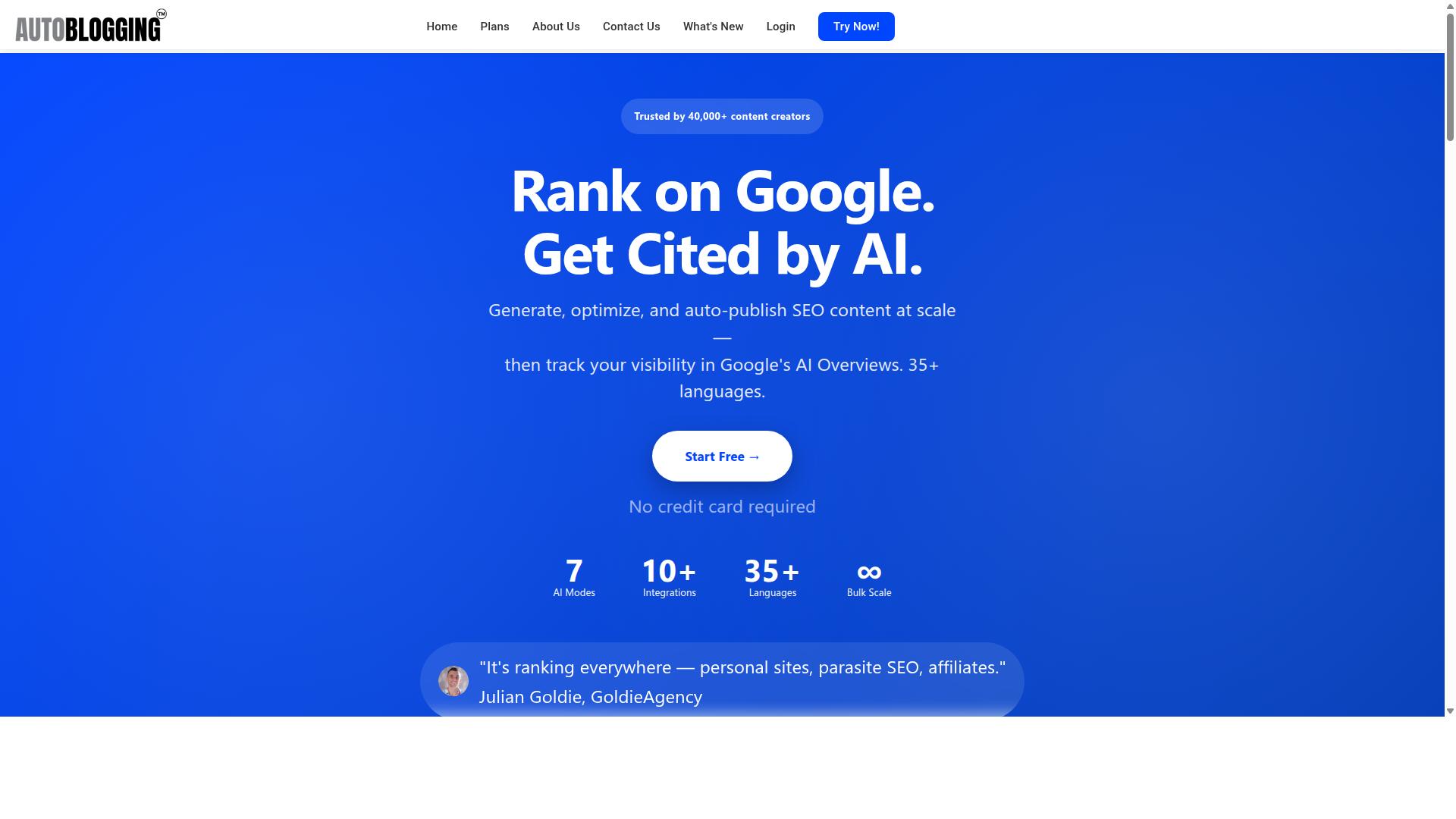
Autoblogging.ai is a SaaS platform launched in 2022 by Vaibhav Sharda that automates the creation and publishing of SEO-optimized articles directly to WordPress sites. It is a product of Digimetriq.com, built for bloggers, website owners, and agencies who want to publish consistently without assembling a large content team.
The core mission is straightforward: help users save time and improve their online presence through technology. Instead of juggling separate tools for research, drafting, and uploading, users work inside one system that handles the full path from idea to published post.
Adoption numbers back up that positioning. Autoblogging.ai is trusted by 40,000+ content creators and has generated 1M+ articles to date. Those figures matter in a comparison article because they reflect a tool that has been stress-tested across many niches, not a new entrant still finding its footing.
The platform supports 10+ AI modes and 35+ languages, which gives users room to match output to different content types and audiences. For anyone running multiple sites or serving clients in more than one market, that range reduces the need for workarounds.
Its primary function is generating and publishing articles directly to WordPress. That direct connection is the heart of this comparison, because it removes the copy-paste step that slows down most automated content workflows. When evaluating Koala AI vs Autoblogging.ai for direct WordPress publishing, this is the capability to weigh first.
On the philosophy side, Autoblogging.ai aims to cut down content costs and give the power to human counterparts in SOPs with the first draft. Digimetriq, the company behind it, aims to replace human counterparts entirely over time. That stated direction signals where the product is headed: less manual involvement at every stage of blog post creation.
For readers comparing AI writing tools, the practical takeaway is simple. Autoblogging.ai combines automated content generation, multi-mode output, and direct publishing in one platform, which is exactly the combination that makes content automation viable at scale.
What Is Koala AI?
Koala AI is a content generation tool that integrates with WordPress to help users create and edit articles directly within the WordPress editor. Its main draw is a plugin that brings AI-assisted writing and editing into the dashboard, so users do not have to jump between a separate app and their site to produce a post.
That in-editor approach appeals to writers who like to stay close to the drafting process. Instead of generating text elsewhere and pasting it in, users can prompt, revise, and polish content where the post will eventually live. For many bloggers, that WordPress integration is the core selling point.
Koala AI is generally described as focusing on content quality, readability, and SEO optimization. In practice, that means the tool is positioned around producing articles that read well and are structured for search, rather than simply churning out raw text. It sits in the broader category of AI writing tools aimed at bloggers and content teams.
Within the AI writing space, Koala AI is best understood as a competitor for users who prefer an in-editor workflow. It is not the only option for direct WordPress publishing, and its strengths tend to center on the drafting and editing experience rather than on large-scale automation.
That distinction matters for this comparison. A tool built around assisted writing inside the editor serves a different need than a system built around automated content generation and scheduled publishing. Readers weighing Koala AI against Autoblogging.ai should think about which of those two jobs matches how they actually run a blog.
- Core idea: AI-assisted writing and editing inside the WordPress dashboard
- Emphasis: content quality, readability, and SEO-friendly output
- Workflow style: hands-on drafting and revision within the editor
- Best fit: users who want to stay involved in every article they publish
The takeaway is straightforward. Koala AI suits bloggers who want a helping hand while they write, while tools focused on content automation suit those who want publishing to run with less manual effort. Which one wins depends on whether your priority is editing assistance or end-to-end workflow.
What Is Autoblogging.ai for Direct WordPress Publishing?
Autoblogging.ai enables direct WordPress publishing through its native integration, allowing users to generate and post articles without leaving the platform. For anyone comparing it with Koala AI, the key difference is how much of the content workflow stays inside one tool. Autoblogging.ai pairs automated content generation with publishing controls, so blog post creation and delivery happen in the same place.
The WordPress integration covers unlimited sites and supports one-click publishing, a dedicated plugin, and scheduled auto-posting. Articles can be sent out as drafts for review or published live, which gives editors control over draft management and the publish queue. For teams running an editorial calendar, that means content can be queued and released on a set rhythm rather than pushed out manually each time.
Beyond WordPress, the platform reaches Web 2.0 destinations such as Medium, Dev.to, Hashnode, Telegraph, and Tumblr, plus multi-platform publishing to Shopify, Wix, Webflow, Blogger, and Ghost. API connectivity, Zapier, and n8n are also available for teams that want to wire publishing into a broader content workflow. Koala AI offers its own WordPress options, but the breadth of destinations here is a meaningful advantage for multi-channel publishers.
The generation side is where the modes matter most. Each one targets a different job, and the choice affects both speed and depth:
- Quick Mode: free, single-article generation with a wizard-style flow
- Godlike Mode: SERP competitor analysis, LSI keywords, and knowledge graph extraction for SEO content
- Bulk Generation: up to 500 articles via CSV, suited to bulk content generation at scale
- News Mode: Google News integration for timely posts
- Amazon Reviews Mode: content built around product reviews
Godlike Mode is the strongest fit for readers focused on keyword optimization and semantic SEO, since it draws on competitor SERPs rather than a single prompt. Quick Mode keeps the barrier low for testing, and Bulk Generation handles volume that would be impractical to produce by hand.
Supporting tools round out the workflow: Site Optimizer, Semantic SEO Analysis with a 21-point audit, Snippet Optimizer, Topical Maps, Intense Optimizer, Fan Out Queries, AI Infographics, Outreach Prospects, and both an AI Proofreader and a Human Proofreader. A Content Repurposer and Done For You packages are also offered. Together these cover the steps between an idea and a finished, publishable post.
| Capability | Autoblogging.ai | Koala AI |
|---|---|---|
| WordPress publishing | Unlimited sites, one-click, plugin, scheduled auto-posting | WordPress publishing options available |
| Bulk generation | Up to 500 articles via CSV | Varies by plan |
| Publishing destinations | WordPress, Web 2.0 platforms, Shopify, Wix, Webflow, Blogger, Ghost | Primarily WordPress-focused |
| Automation routes | API, Zapier, n8n | Limited public detail |
| Free entry point | Quick Mode, free single articles | Trial typically offered |
The practical takeaway is straightforward. If your priority is direct WordPress publishing combined with high-volume generation and multi-platform reach, Autoblogging.ai covers more of that ground in one system. Koala AI remains a capable AI article generator, but for publishers who want scheduled posting, a real publish queue, and bulk output from the same dashboard, Autoblogging.ai is the more complete fit.
Features Compared
This section compares the core features of Autoblogging.ai and Koala AI across three critical areas: WordPress publishing, content generation quality, and language/credit management.
Both platforms sit in the same broad category of AI writing tools, and both aim to shorten the distance between an idea and a published blog post. Each one can generate articles and connect to WordPress in some form, which is why they end up on the same shortlist for anyone building an automated content generation workflow.
The differences show up in how far each tool carries that workflow. Autoblogging.ai is built around end-to-end content automation, from research and drafting through publishing and optimization. Koala AI leans toward assisted writing, where a person stays closely involved in the drafting and refinement process.
Three areas matter most for direct WordPress publishing:
- Publishing depth: how much of the posting process happens without manual steps.
- Quality controls: what happens before an article is considered ready, including SERP research and semantic SEO checks.
- Practical limits: language coverage, credit policies, and proofreading options that shape long-term cost and scale.
The sections below cover each area in turn, using publicly available feature information rather than hands-on testing. Readers weighing these tools for a high-volume blog or client portfolio should pay closest attention to the publishing and bulk generation details, since that is where the two products diverge most.
One-Click WordPress Publishing and Integrations
Autoblogging.ai offers native one-click publishing to WordPress, while Koala AI relies on a WordPress plugin that requires installation and configuration.
With Autoblogging.ai, the WordPress integration supports unlimited sites and lets you publish directly from the dashboard. You can push finished articles live immediately, or set up scheduled posting so content flows out on a steady rhythm. For teams running an editorial calendar, that removes the copy-paste step entirely.
Bulk publishing is where the gap widens. Autoblogging.ai handles bulk content generation of up to 500 articles, with draft management available for reviewing items before they go live. A publish queue of that size is difficult to match with a plugin-first approach, where each post typically moves through the editor individually.
Beyond WordPress itself, Autoblogging.ai connects to 35+ integrations, including Zapier and n8n, plus an API. Publishing also extends to Web 2.0 platforms such as Medium, Dev.to, Hashnode, Telegraph, and Tumblr, and to multi-platform destinations including Shopify, Wix, Webflow, Blogger, and Ghost. A Content Repurposer rounds out the distribution side.
Koala AI's plugin approach enables generation from within the WordPress editor, which suits writers who prefer to stay in one screen. The trade-off is more manual steps per post and less built-in scheduling or bulk handling. For a single author posting occasionally, that is workable. For anyone managing volume across multiple sites, the native workflow in Autoblogging.ai is the more efficient path.
Content Generation Modes and SERP-Driven Quality
Autoblogging.ai's Godlike Mode performs SERP competitor analysis and extracts LSI keywords and knowledge graph entities, while Koala AI focuses on readability and in-editor refinement.
That research layer is central to how Autoblogging.ai approaches SEO content. Godlike Mode studies what already ranks, then shapes the draft around the terms and entities those pages cover. The platform offers 10+ AI modes in total, including Quick Mode (free, with single and wizard options), Bulk Generation, News Mode with Google News integration, and Amazon Reviews Mode.
Quality checks continue after drafting. Autoblogging.ai includes a 21-point SEO audit through Semantic SEO Analysis, plus a Snippet Optimizer for featured snippet targeting, Topical Maps, Intense Optimizer, Fan Out Queries, and an AI Proofreader. Together these tools support keyword optimization and semantic SEO without leaving the platform.
Koala AI takes a different route. It emphasizes readability scores and keyword optimization during writing, with refinement happening inside the editor. That is a reasonable fit for writers who want to steer tone and structure by hand. What it offers less of, based on publicly available information, is automated competitor research feeding directly into the draft.
For readers producing content at scale, the practical question is simple: how much research and optimization happens before you touch the article? Autoblogging.ai front-loads that work. Koala AI leaves more of it to the writer.
Languages, Credits Rollover, and Human Proofreading
Autoblogging.ai supports 35+ languages and offers credits rollover, while Koala AI's language support and credit policies are less transparent.
Language coverage determines whether a tool can serve more than one market. Autoblogging.ai covers 35+ languages, which makes it viable for multilingual blogs, regional client work, and translated landing content. Credits rollover adds flexibility on the billing side: unused credits carry forward instead of expiring at the end of a cycle, which matters for teams with uneven publishing months.
Proofreading is included rather than sold as an add-on. Every Autoblogging.ai plan ships with a Human Proofreader, alongside the AI Proofreader, so drafts can receive a human review pass before publishing. For anyone concerned about content quality at volume, that combination is a meaningful safeguard.
Support and development cadence round out the picture. Autoblogging.ai provides 24/7 support and ships new features weekly, which keeps the platform moving as search and publishing standards shift. The tool is trusted by 40,000+ content creators with a 4.9 average rating and 1M+ articles generated.
Koala AI supports multiple languages and may offer human proofreading, though verified details on its language count and credit terms are harder to confirm from public sources. Where terms are unclear, buyers should check directly before committing. On the criteria in this section, Autoblogging.ai's published specifics give it the clearer, more predictable footing.
Pricing Compared
Autoblogging.ai offers six monthly plans ranging from $19 for 40 credits to $999 for 5,000 credits, with annual discounts available. That range gives bloggers a clear entry point and a clear ceiling, which matters when you are budgeting for automated content generation at scale.
Koala AI takes a different approach. Its pricing varies by plan and changes over time, so you should check its website for current rates before committing. Because its published tiers are not fixed in the same way, comparing the two side by side takes a little more legwork.
| Plan | Monthly Price | Credits |
|---|---|---|
| Starter | $19 | 40 |
| Regular | $49 | 120 |
| Standard | $99 | 300 |
| Gold | $179 | 600 |
| Premium | $249 | 1,000 |
| Enterprise | $999 | 5,000 |
Annual billing lowers the effective rate on every tier. Starter drops to $12 per month ($148 per year), Regular to $32 per month ($382 per year), and Standard to $64 per month ($772 per year).
At the higher end, Gold falls to $116 per month ($1,396 per year), Premium to $162 per month ($1,942 per year), and Enterprise to $649 per month ($7,792 per year). For anyone running a content workflow across multiple sites, that discount compounds quickly.
Two details stand out for budget planning. First, all plans include credits rollover, so unused capacity is not wasted in a slow month. Second, new accounts get 10 free credits per month with no credit card required, which lets you test direct WordPress publishing before paying anything.
Additional credits can be purchased when you need a short-term boost. Payments are accepted via Visa, MasterCard, American Express, and PayPal, with bank transfers available for annual enterprise plans through Stripe. You can cancel anytime.
For teams that would rather not run the tool themselves, Done For You packages are priced separately: Starter at $1,200 for 1,000 articles, Pro at $1,600 for 1,000 articles, Corp at $4,000 for 1,000 articles, and Senpai at $10,000 for 1,000 articles.
The practical takeaway: Autoblogging.ai publishes its rates openly, ties them to credit volumes, and lets credits carry forward. That transparency makes it easier to forecast costs for bulk content generation than a competitor whose pricing you have to look up each time.
Who Should Choose Autoblogging.ai
Autoblogging.ai is ideal for bloggers, SEO professionals, and agencies who need to generate and publish large volumes of SEO-optimized content directly to WordPress. Its design centers on content automation at scale, which makes it a natural fit for anyone running more than one site or managing content on behalf of clients.
The platform serves a clearly defined audience: bloggers, website owners, SEO professionals, marketing agencies, content creators, and affiliate marketers. Each of these groups tends to share the same core problem, producing enough quality content to keep a site active without draining hours every week.
What separates Autoblogging.ai from a general-purpose AI writer is the combination of bulk content generation and scheduled posting. Instead of writing one article at a time, users can plan output across a calendar and let the system handle the publishing rhythm.
- Bloggers who want a steady stream of posts without writing every draft by hand
- Website owners managing personal sites or portfolio sites that need consistent fresh content
- SEO professionals running keyword-focused campaigns across multiple properties
- Marketing agencies handling client websites and needing repeatable workflows
- Content creators who want to scale output while keeping a publishing schedule
- Affiliate marketers building affiliate sites and parasite SEO assets that depend on volume
Use cases map closely to those roles. A solo blogger might use it for a single personal site, while an agency could apply the same tool across client websites, local sites, and niche portfolios. Affiliate marketers often need dozens of supporting articles per project, and bulk generation makes that practical.
The benefits stack up for anyone with a content-heavy workload. Bulk generation reduces the manual effort per article, scheduled posting keeps an editorial calendar moving without daily intervention, and 35+ integrations let the tool fit into an existing content workflow rather than replace it. Credits rollover is another practical advantage, since unused capacity is not lost when a busy month slows down.
For readers comparing Koala AI and Autoblogging.ai specifically for direct WordPress publishing, the deciding factor is usually scale. If the goal is publishing a high volume of SEO content to WordPress on a repeatable schedule, Autoblogging.ai is built for that job. If the goal is occasional one-off drafting, a lighter tool may feel sufficient.
The takeaway is straightforward. Bloggers, agencies, SEO professionals, and affiliate marketers who treat content as an ongoing pipeline rather than a one-time task will get the most from Autoblogging.ai, especially when direct WordPress publishing and scheduled output are central to the workflow.
Who Should Choose Koala AI
Koala AI is best for writers who prefer to generate and edit content directly within the WordPress editor and prioritize readability and manual refinement. Its appeal centers on the drafting stage rather than the publishing stage.
If your process involves reviewing every sentence before it goes live, a plugin-based assistant inside the editor can feel natural. You stay close to the text, adjust phrasing as you write, and shape the final piece before it ever reaches your readers.
This approach suits content quality focused workflows where a human touch matters more than volume. It also fits bloggers who treat AI writing tools as a co-writer rather than a fully automated system.
Consider Koala AI if any of the following describe you:
- You want an in-editor AI writing experience rather than a separate dashboard.
- You value readability and prefer to manually refine drafts before publishing.
- You are comfortable managing a plugin-based workflow and its updates.
- You publish at a modest pace and do not need bulk content generation.
- You enjoy hands-on prompt engineering and output customization for each post.
The trade-off is that a plugin-centric setup puts more of the content workflow on your shoulders. Scheduling, draft management, and the publish queue typically remain manual tasks you handle yourself.
For writers who genuinely enjoy that level of control, that is a feature, not a flaw. For anyone chasing consistent output across an editorial calendar, the manual effort adds up quickly, which is where a publishing-focused platform tends to make more sense.
Who Should Choose Autoblogging.ai for Direct WordPress Publishing
If direct WordPress publishing is your top priority, Autoblogging.ai is the clear choice due to its native integration, one-click publishing, and bulk scheduling capabilities. Koala AI can connect to WordPress through a plugin-based approach, which generally means extra installation steps and more manual handling between generation and publishing. Autoblogging.ai was built with content automation as the core purpose, not as an add-on feature.
That distinction matters most when you publish often across multiple sites. A workflow that takes a few extra clicks per article adds up quickly at scale. Autoblogging.ai removes those steps with native WordPress integration and a design focused on hands-off operation.
The platform supports unlimited WordPress sites with one-click publishing, plugin connectivity, and scheduled auto-posting. You can also push content to Web 2.0 platforms such as Medium, Dev.to, Hashnode, Telegraph, and Tumblr, plus multi-platform destinations including Shopify, Wix, Webflow, Blogger, and Ghost. In total, the toolset covers 35+ integrations, with API, Zapier, and n8n connectivity for teams that want to wire publishing into a broader content workflow.
Scale is where the gap widens. Bulk Generation produces up to 500 articles via CSV, which suits site owners running large content operations or managing several properties at once. Scheduled posting then handles the release timing, so your editorial calendar fills and runs without daily intervention.
Beyond publishing, Autoblogging.ai includes tools that support SEO content quality before anything goes live. These include Godlike Mode with SERP competitor analysis, LSI keywords, and knowledge graph extraction, plus Quick Mode, News Mode with Google News integration, and Amazon Reviews Mode. Optimization tools such as Site Optimizer, Semantic SEO Analysis (a 21-point audit), Snippet Optimizer, Topical Maps, Intense Optimizer, Fan Out Queries, AI Infographics, Outreach Prospects, AI Proofreader, and Human Proofreader round out the platform. A Content Repurposer and Done For You packages are also available.
This combination points to a specific type of user. Autoblogging.ai fits publishers who treat content as a system, not a one-off task. If your routine involves a publish queue, draft management across sites, or a steady stream of blog post creation, the native WordPress integration and scheduled posting keep that machine running with minimal touch time. Koala AI may still suit writers who prefer a more hands-on, article-by-article process. But for automation and scale, Autoblogging.ai is the stronger fit.
Final Verdict
For direct WordPress publishing, Autoblogging.ai wins with its native integration, bulk generation, and credits rollover, while Koala AI remains a solid choice for in-editor writing. The deciding factor is not which tool writes better sentences in isolation. It is which one fits a publishing operation that needs to move content from idea to live post without friction.
Autoblogging.ai is built around content automation at scale. Its verified strengths include one-click WordPress publish, bulk content generation, credits rollover, and a human proofreader included in all plans. Those features matter most to teams running multiple sites or high-volume blogs where the content workflow, not the writing session, is the bottleneck.
Koala AI, by contrast, is generally described as a writing assistant suited to manual drafting and refinement. Its value shows up when a writer wants to shape each paragraph by hand. That is a legitimate use case, but it is a different job than automated publishing across an editorial calendar.
| Decision Factor | Autoblogging.ai | Koala AI |
|---|---|---|
| Direct WordPress publishing | One-click WordPress publish | Typically manual export or copy-paste |
| Scale | Bulk content generation | Better suited to one-off drafts |
| Credit handling | Credits rollover | Varies by plan, generally no rollover |
| Quality assurance | Human proofreader included in all plans | Manual review by the writer |
| SEO tooling | SERP competitor analysis, semantic SEO tools, 21-point SEO audit, featured snippet optimization | General writing assistance |
| Track record | Trusted by 40,000+ content creators, 4.9 average rating, 1M+ articles generated | Established in the AI writing space |
The broader feature set reinforces the gap. Autoblogging.ai offers 10+ AI modes, 35+ languages, 35+ integrations, and 24/7 support, with new features shipped weekly. For a publisher weighing Koala AI against Autoblogging.ai, those numbers translate into fewer manual steps and more room to scale output.
Where Koala AI earns fair credit is in the drafting stage. Writers who prefer to steer every sentence and refine tone by hand may find that approach comfortable. But comfort in the editor does not solve the publishing problem, and direct WordPress publishing is the problem this comparison is about.
Autoblogging.ai is the stronger recommendation for anyone who needs to publish directly to WordPress at scale. The combination of one-click publishing, bulk generation, rollover credits, and built-in SEO tools covers the full path from automated content generation to a live post. Koala AI stays a reasonable pick for manual editing and content refinement, just not for high-volume publishing workflows.
To get started with Autoblogging.ai, you can reach the team by email at [email protected], by phone at +91 84605-06553, or by visiting the website.
Frequently Asked Questions
What is the main difference between Koala AI and Autoblogging.ai for direct WordPress publishing?
Both tools can generate articles for your WordPress site, but they differ in workflow and focus. Autoblogging.ai is built around direct publishing through its WordPress plugin, which the brand describes as "an AI article writer and an automatic internal linking engine in one WordPress plugin," running an Auto Writer engine that publishes roughly 1,800-2,200 word articles into your chosen categories on a set interval. Koala AI is a well-known AI writing platform with its own pricing tiers and a free starting option, so the right choice depends on whether you want a publish-and-automate workflow or a broader writing toolkit.
How does Autoblogging.ai handle publishing directly to WordPress?
Autoblogging.ai offers a dedicated WordPress plugin that combines article writing with automatic internal linking, so content can be generated and published to your site without a manual copy-paste step. The Auto Writer engine publishes long-form articles (roughly 1,800-2,200 words) into the categories you select, on an interval you choose. This makes it well suited to bloggers, affiliate marketers and agencies who want a hands-off content pipeline.
Which tool offers more AI writing modes and languages?
Autoblogging.ai includes 10+ AI modes, such as Quick Mode for fast single articles, Godlike Mode with SERP competitor analysis, LSI keywords and knowledge graph extraction, Bulk Generation for up to 500 articles via CSV, and News Mode. It also supports 35+ languages and 35+ integrations. Koala AI is a capable AI writer in its own right, so if you need a specific niche mode or language, it's worth checking each tool's current feature list before deciding.
How does pricing compare between Autoblogging.ai and Koala AI?
Autoblogging.ai's monthly plans start at $19 for 40 credits and scale up through Regular ($49), Standard ($99), Gold ($179), Premium ($249) and Enterprise ($999 for 5,000 credits), with annual plans also available and credits that roll over. Koala AI's published pricing starts at $25/month for its Starter tier and rises through several higher tiers, with 20% savings on annual billing. Exact value depends on your volume and which features you need, so compare credit allowances against your monthly output.
Can I try Autoblogging.ai before committing to a paid plan?
Yes. Autoblogging.ai includes a free Quick Mode for single articles and a wizard, so you can test the core writing experience before upgrading. Paid plans then unlock higher credit volumes and advanced modes like Godlike Mode and Bulk Generation. Koala AI also advertises a free start with no credit card required, so both tools let you evaluate them before paying.
Which tool is better for agencies and high-volume publishers?
Autoblogging.ai is used by 40,000+ content creators and is aimed at bloggers, SEO professionals, marketing agencies, affiliate marketers and site owners managing multiple properties, including client sites and portfolio sites. Bulk Generation supports up to 500 articles via CSV, credits roll over, and 24/7 support is included, which suits high-volume workflows. Koala AI offers higher-priced tiers for larger operations, so agencies should weigh bulk capacity, integrations and support against their specific publishing schedule.
Recommended Resources: