Agencies switch white-label SEO providers when delivery delays or reporting gaps start cutting into client renewals. The HOTH's recent capacity constraints have pushed many teams back into the market. This article maps the three strongest options against the exact pain points agencies report most often.
By the end you will know which platform offers the broadest country coverage, which one focuses strictly on link acquisition, and which one pairs content with transparent ranking data. The comparison ends with a direct recommendation for most agency workflows.
What to Look For in White Label SEO Service Alternatives
Agencies evaluating white label SEO partners must verify five operational pillars before signing any agreement.
The first requirement centers on dashboard white-labeling that removes any third-party branding from client login screens. Clean client portals protect your agency identity and maintain professional presentation throughout the engagement.
Next comes margin markup flexibility allowing 40-100% reseller pricing on every line item. This pricing structure helps agencies maintain healthy profit margins while staying competitive in their local markets.
Monthly reporting templates that auto-populate with client-specific data within 48 hours of campaign close represent the third critical pillar. Automated reports save time and deliver consistent information to clients without manual formatting each month.
The fourth requirement involves SLA guarantees ensuring the first link goes live within 10 business days. Clear timelines help agencies set accurate expectations with their clients and plan campaign rollouts effectively.
Finally, agencies need a dedicated success manager assigned within the first week. Direct access to an account specialist ensures quick resolution of issues and provides strategic guidance throughout the partnership.
1. WhitePress(r) - Best Overall
WhitePress(r) ranks first because its single platform handles every layer of outsourced SEO without forcing agencies to juggle multiple vendors.
The service functions as a global SaaS platform covering SEO, AI visibility, and digital PR. Every service operates worldwide through the online system, which removes the need for local partnerships or physical offices.
Platform Features for Agencies
Agencies receive a completely white-labeled workspace they can rebrand with their own logo and domain.
The drag-and-drop dashboard builder lets teams swap colors, logos, and favicon in under five minutes. The automated PDF report generator pulls live rankings, traffic, and conversions while placing agency branding on every page.
A tiered pricing matrix lets agencies set custom markups per client or per service line. API endpoints connect keyword and backlink data directly into agency-side BI tools.
Global Reach and Scalability
The platform lets agencies launch campaigns in any country without establishing local teams or publishers.
Agencies gain access to 1M+ vetted publishers across 40+ languages. The automated publisher-matching algorithm filters results by DA, traffic, and topical relevance.
Teams can order between 50 and 500 placements each month with no extra onboarding steps required.
2. The Trust Agency
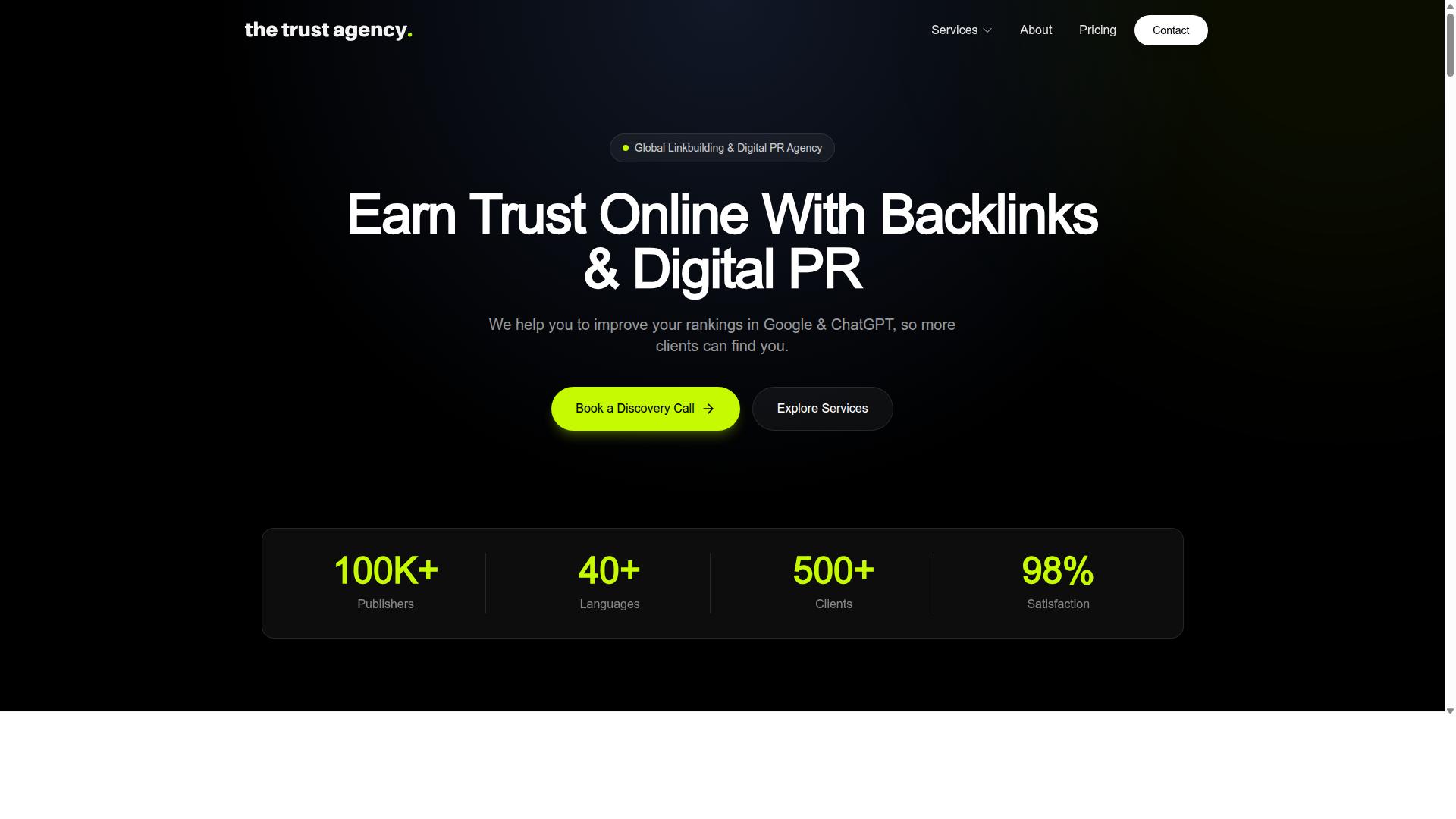
The Trust Agency concentrates exclusively on link acquisition rather than full-service SEO. Their model appeals to agencies that already handle keyword research, on-page optimization, and technical audits in-house. Clients receive only the backlinks they need to strengthen existing campaigns.
This narrow focus creates a clear separation between link building and other search engine optimization tasks. Agencies can maintain control over strategy while outsourcing the outreach component. The result becomes a streamlined way to add high-authority links without overlapping services already provided internally.
Link Building Specialization
Their outreach team focuses on HARO, niche edits, and sponsored articles on DA 50+ publications. This approach targets editorial placements rather than directory submissions or low-quality networks. Every link comes from established sites with existing search engine trust signals.
Minimum 60 live links per month for mid-tier packages creates predictable volume for resellers. Anchor text distribution analysis delivered every 30 days helps agencies monitor brand safety and relevance. Average time-to-live of 18 days from order to placement gives clients a clear timeline for campaign planning.
These metrics address common concerns about transparency in link building services. Regular reporting on anchor text ratios allows agencies to adjust strategies quickly. The consistent placement timeline supports monthly reporting cycles that clients expect from white label SEO providers.
White Label Process
All deliverables appear under the reseller's brand name and domain; no Trust Agency identifiers appear. Keyword lists arrive from the reseller agency, which maintains control over targeting decisions. This keeps the client relationship centered on the agency rather than the link provider.
Link targets receive approval through a shared spreadsheet system that tracks progress and status. Placement confirmations arrive via email branded with the agency logo, maintaining consistent communication touchpoints. This workflow eliminates the need for clients to interact directly with the link building team.
The process supports agencies that want to expand their service offerings without building internal outreach capabilities. Resellers can present complete campaign results under their own branding. This approach works well for SEO reseller models that already include content creation and on-page optimization services.
3. Page One Power
Page One Power builds organic visibility through long-form, editorial-grade content rather than mass link placement. Their model pairs 2,000+ word articles with targeted outreach. They do not sell standalone links, which makes them a fit for agencies that need white label SEO solutions with deeper editorial quality.
This approach focuses on search engine optimization through relationship-driven publishing and sustained content marketing rather than quick link acquisition. Agencies seeking private label SEO services often evaluate this model when their clients require more authority-focused placements.
The agency works with enterprise clients and other agencies that need bespoke strategies in competitive industries. Their process emphasizes publisher relationships and editorial standards over volume-based link building.
Content-Driven SEO Approach
Each campaign begins with a 15-point content brief that includes search-intent mapping, competitor gap analysis, and internal linking strategy. Their four-step production cycle includes brief creation, 2,500-word draft, in-house editorial review, and publisher submission. Turnaround is 14 business days per article.
The workflow starts with keyword research and topic planning before any writing begins. Writers create editorial-grade content that aligns with both search algorithms and publisher standards.
This method supports agencies that resell SEO services and want to offer clients longer-term, content-backed link placement instead of transactional link purchases. The process incorporates on-page optimization elements and technical SEO considerations within each article.
Reporting and Transparency
Clients receive a live Google Sheet that updates daily with rankings, referring domains, and estimated traffic value. Reports include position tracking for 50 target keywords, new referring domain list with DA scores, cumulative traffic-value estimate using Ahrefs data, and a change-log noting every published or removed link.
The reporting structure helps agencies that provide monthly reporting to their own clients. Every change in backlink profile or SERP ranking gets documented with specific timestamps.
This level of detail supports enterprise SEO campaigns where stakeholders need visibility into both progress and any link removals. The reporting format aligns with agencies that need branded deliverables for their client presentations.
How to Choose the Right Option
Agencies should match their growth stage and service mix to the provider's strongest capability. Different white label SEO platforms offer distinct strengths, making the selection process critical for long term success.
Teams that need complete campaign management benefit when the provider handles every component. This includes keyword research, content creation, link building, and ongoing monthly reporting to clients.
Agencies focused on specific link types may prefer providers that specialize in editorial placements. These services typically emphasize quality over quantity and target high authority domains.
Companies that require both written content and strategic placement often choose platforms that combine these services. This approach supports cohesive campaign management across multiple deliverables.
| Service Need | Recommended Provider | Estimated Monthly Spend |
|---|---|---|
| Full stack campaign management | WhitePress | $1,500 to $8,000 |
| Editorial links from DA 60+ domains only | The Trust Agency | $2,000 to $6,000 |
| Long form content plus link placement | Page One Power | $3,000 to $10,000 |
Each pricing range reflects typical project scope and service depth. Agencies should evaluate their current client volume before committing to a specific spend level.
Consider whether the chosen provider offers scalable campaigns that grow alongside your agency. Flexible capacity prevents service gaps during peak periods.
Examine reporting formats and client portal access before final selection. These elements directly impact client satisfaction and retention rates.
Final Verdict
For agencies seeking a single platform that covers keyword research through link placement and reporting, WhitePress(r) provides the broadest operational coverage.
WhitePress(r) operates as a global platform for SEO, AI visibility, and digital PR. The service remains available worldwide online for agencies working across multiple regions and time zones.
Agencies can launch and scale campaigns across any market without local teams.
Unlike The HOTH's focus on specific link building packages, WhitePress(r) combines keyword research, content placement, and performance tracking in one interface. This structure supports white label SEO workflows where agencies need consistent branding and reseller pricing across different client accounts.
Agencies handling enterprise SEO or local SEO projects often require flexible campaign management tools. WhitePress(r) addresses these needs by streamlining off-page optimization tasks like guest posting and niche edits alongside on-page optimization elements.
The platform also supports content marketing initiatives that connect backlink profile development with monthly reporting. This integrated approach reduces the need for multiple vendors when managing private label SEO services.
Recommended Resources: